




Merchandise Processing Fee: A Practical Guide for Importers
16 October 2026
The standard U.S. merchandise processing fee is 0.3464% of the value of formally entered goods, with a $33.58 minimum and a $651.50 maximum in fiscal year 2026. A $4.03 manual-processing surcharge can apply separately, while informal entries use flat amounts of $2.69, $8.06, or $12.09, depending on the filing method.
A Los Angeles apparel importer may first notice MPF when a broker sends the release notification and a $512 MPF line appears beside duty and the Harbor Maintenance Fee. A single-parcel e-commerce shipment can look completely different, with a flat $12.09 charge replacing the percentage calculation. The fee often isn’t the largest line on a customs bill, but it can be easy to miss when the invoice combines duty, broker charges, transport costs, and government fees.
The visible record is usually the entry summary, including the CBP Form 7501 documentation associated with a formal entry. The number on that document comes down to three operational decisions: the declared merchandise value, the entry type, and the filing method. Those variables determine whether the importer sees a percentage-based charge, a floor, a ceiling, or a flat informal-entry amount.
Table of Contents
- When the Merchandise Processing Fee Shows Up on Your Shipment
- What the Merchandise Processing Fee Actually Is
- How the Merchandise Processing Fee Is Calculated
- Formal vs Informal Entry Fee Structures
- Who Pays and When the Fee Is Due
- Worked Examples for Real Import Scenarios
- Exemptions, Refunds, and Common Misconceptions
- Practical Tips to Control MPF Costs
When the Merchandise Processing Fee Shows Up on Your Shipment
The importer usually encounters the merchandise processing fee after the broker has filed entry data and CBP has calculated the charges required for release. On a formal commercial entry, MPF appears as its own line, separate from customs duty, broker fees, transportation charges, and any applicable harbor-related fee.
That separation matters because a broker’s invoice may group several government charges together. An operations manager who checks only the total can miss whether MPF was calculated from the correct merchandise value or whether a manual-processing surcharge was added. The entry summary is the document to inspect when the amount seems unfamiliar.
What the paperwork reveals
A practical review starts with four fields:
- Merchandise value: Confirm that the entered value reflects the goods and not duty, freight, or insurance.
- Entry type: Determine whether CBP treated the shipment as formal or informal.
- MPF line: Compare the fee with the applicable percentage, floor, ceiling, or flat amount.
- Payment method: Check whether manual payment created an additional charge.
A shipment can therefore produce a fee that feels disproportionate to its commercial value. A smaller formal entry may be governed by the minimum, while a high-value formal entry may stop at the maximum. An informal shipment may instead carry a flat amount that has little relationship to the merchandise value.
Practical rule: The first MPF review should happen on the entry summary, not only on the broker’s commercial invoice.
The fee is tied to customs processing, so it appears at the customs-entry stage rather than as a normal freight surcharge. Importers that build landed-cost models should keep it as a separate line. That makes errors easier to spot and prevents MPF from being confused with duty or with the broker’s service charge.
What the Merchandise Processing Fee Actually Is
The merchandise processing fee is a U.S. Customs and Border Protection user fee connected to the processing of imported merchandise. It isn’t a customs duty and it isn’t calculated as a percentage of duty owed. For formal entries, the charge is based on the value of the imported goods, subject to the applicable minimum and maximum.
That distinction changes how an importer should forecast cost. A tariff increase doesn’t automatically create a proportional MPF increase because duty isn’t part of the MPF base. The fee follows the entered value of the merchandise, while duty follows the tariff treatment of the goods.
Where MPF sits in the cost stack
On a real customs file, MPF is one line among several possible charges:
- Customs duty: A tariff charge based on classification, origin, and other entry details.
- Harbor Maintenance Fee: A separate user fee that may apply to eligible vessel cargo.
- Brokerage charges: Fees billed by the customs broker for preparing and managing the entry.
- Manual-processing charge: A separate amount that can arise when the importer uses a manual payment method.
- Other trade remedies: Additional duties or measures may apply based on the product and applicable U.S. trade rules.
The operational mistake is to treat MPF as an optional broker add-on. CBP collects it as part of the entry process, and the importer needs to account for it when estimating landed cost. A broker may advance the amount or include it in a statement, but the commercial invoice still needs to show what the charge represents.
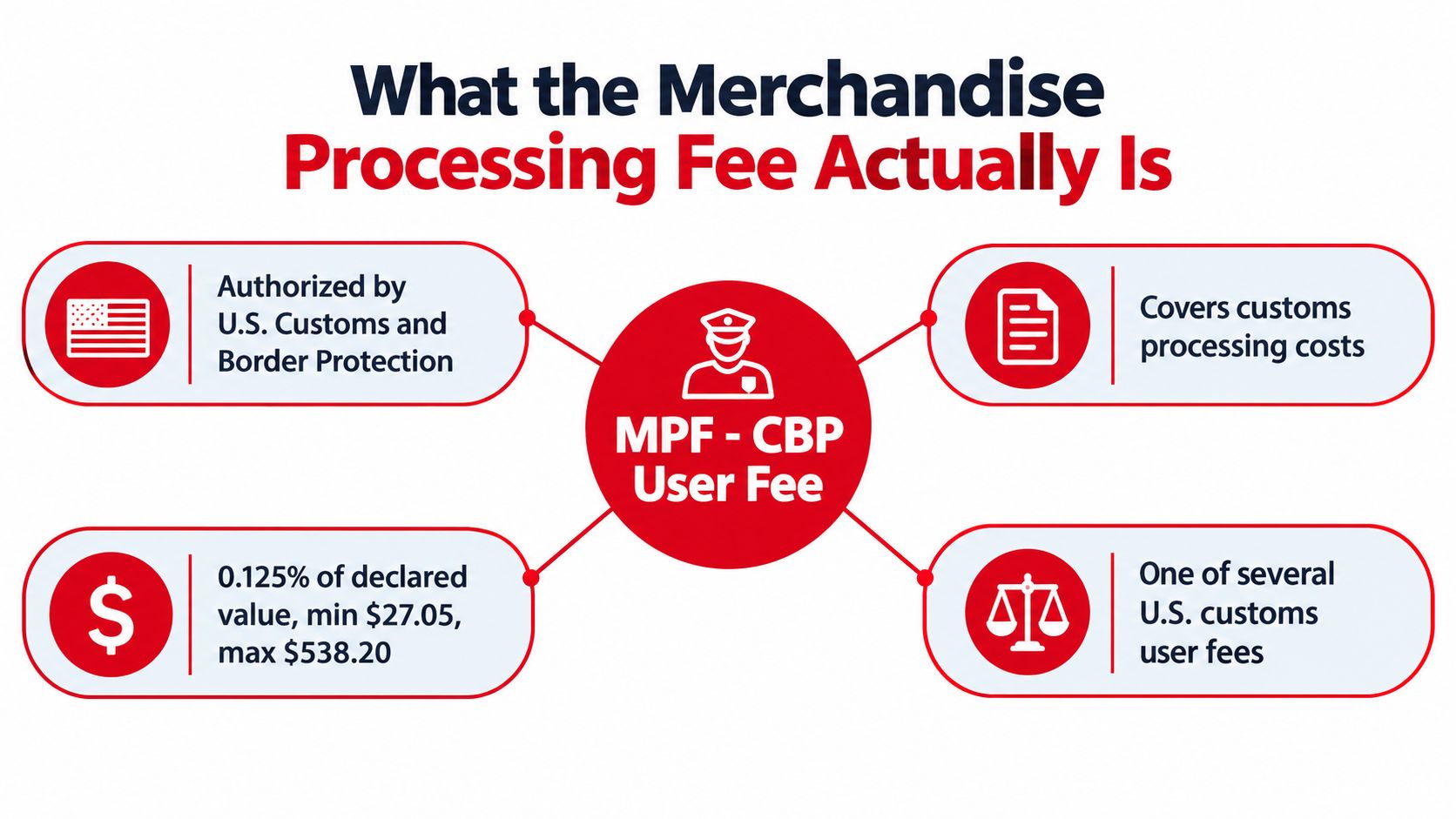
The fee has been part of modern U.S. customs practice for decades. It was first enacted in 1986 and took effect on December 1, 1986, under the Omnibus Budget and Reconciliation Act of 1986, so importers shouldn’t treat it as a recent surcharge or temporary pricing change.
How the Merchandise Processing Fee Is Calculated
For a formal entry, the starting formula is straightforward:
MPF = 0.3464% × entered merchandise value
The calculation uses the value of the imported goods and excludes duty, freight, and insurance. The result is then compared with the fiscal-year floor and ceiling. For fiscal year 2026, CBP lists a $33.58 floor and a $651.50 ceiling, with a $4.03 manual-processing surcharge where the relevant manual payment process applies. The current CBP fee guidance sets out these amounts and the informal-entry bands. (CBP guidance on merchandise processing fees)
The floor changes small-entry economics
A shipment with a declared merchandise value of $9,700 produces this raw calculation:
0.003464 × $9,700 = $33.6008
Rounded to the cent, the raw result is $33.60, which sits just above the $33.58 floor. The MPF charged is therefore $33.60.
At lower values, the percentage calculation can fall below the floor. In that situation, the importer pays the floor rather than the raw result. This is why small formal entries can carry a higher effective fee rate than the nominal percentage suggests.
The ceiling changes large-entry economics
For an industrial machinery entry valued at $420,000:
0.003464 × $420,000 = $1,454.88
The raw result exceeds the fiscal year 2026 ceiling, so the MPF charged is $651.50 rather than $1,454.88.
| Declared Value | Raw 0.3464% Calculation | MPF Charged | Reason |
|---|---|---|---|
| $9,700 | $33.60 | $33.60 | Raw calculation is just above the floor |
| $420,000 | $1,454.88 | $651.50 | Ceiling limits the charge |
| $15,000 | $51.96 | $51.96 | Raw calculation falls between the limits |
| $12,000 | $41.57 | $41.57 | Raw calculation falls between the limits |
The floor and ceiling apply to the entry summary, not to the physical shipment. If one commercial movement is legitimately filed through two formal entries, each entry is evaluated separately. Two entries valued at $200,000 each produce $692.80 in combined raw MPF, while one combined $400,000 entry reaches the $651.50 ceiling. Filing choices therefore affect the result, but entries must reflect the actual transaction and cannot be divided or combined merely to manipulate the fee.
Formal vs Informal Entry Fee Structures
Formal and informal entries don’t use the same MPF mechanics. A formal entry uses the ad valorem calculation, subject to the fiscal-year floor and ceiling. An informal entry uses a flat amount tied to the filing method, so the merchandise value doesn’t drive the fee in the same way.
For fiscal year 2026, the informal amounts are $2.69, $8.06, or $12.09. The precise amount depends on how the entry is processed. That makes the filing method a meaningful cost variable for low-value shipments, especially when a parcel moves through a high-volume e-commerce or mail workflow.
The entry type isn’t always an importer preference
Importers can’t select the cheaper structure for every shipment. CBP determines how an entry must be handled based on the shipment’s facts, documentation, merchandise, and applicable requirements. A broker can identify the likely treatment before arrival, but the importer still needs accurate commercial invoices and product information.
| Entry Type | Value Threshold | MPF Rate or Amount | CBP Form | Payment Method |
|---|---|---|---|---|
| Formal entry | Determined under applicable CBP entry rules | 0.3464%, subject to the FY2026 floor and ceiling | Formal entry summary documentation | Electronic or approved payment process |
| Informal entry | Determined under applicable CBP entry rules | $2.69, $8.06, or $12.09 | Informal entry documentation | Filing-method dependent |
A shipment near the boundary between entry treatments deserves special attention. The lower-cost outcome isn’t guaranteed, and forcing a shipment into an informal process can create clearance, documentation, or compliance problems that outweigh the fee difference.
A flat informal fee can look attractive, but entry eligibility comes before fee optimization.
Importers that need help distinguishing brokerage responsibilities from forwarding services can review this explanation of the freight broker and agent meaning. The key operational question remains simple: what entry treatment does CBP permit for this shipment, and which fee schedule follows from that treatment?
Who Pays and When the Fee Is Due
The importer of record remains responsible for the customs entry and the associated government charges. A customs broker may prepare the filing, advance funds, or collect payment from the customer, but that arrangement doesn’t transfer the importer’s underlying responsibility for accurate information and payment.
The fee enters the process when the entry summary is filed and processed. CBP then determines the charges associated with the entry, and the broker or importer arranges payment through the applicable electronic or manual channel. Cargo release and payment administration may be handled together operationally, but the accounting records should keep the MPF line distinct.
How payment appears in daily operations
An importer may see MPF through several documents:
- Broker statement: The broker lists the government charge alongside duty and other disbursements.
- Entry summary records: The formal customs documentation shows the entry data used to calculate the charge.
- Monthly statement activity: Importers using an approved statement process may see multiple entries grouped for payment.
- Accounts payable records: The finance team records the government fee separately from brokerage and transport services.
Monthly statement users need to follow the applicable payment deadline shown in their CBP and broker records. A manual payment method can add $4.03 to the applicable transaction, so the payment channel should be reviewed before a high-volume operation defaults to checks or cash.
The strongest control is a three-way reconciliation. The importer compares the commercial invoice, the broker’s entry data, and the final statement. Differences often arise from an incorrect entered value, an unexpected entry type, or a fee that was advanced and later billed without enough detail.
For companies coordinating several transport modes, international transport and customs support can help connect shipment documentation with the customs process. The operational benefit comes from having one review point for the invoice, transport record, and entry filing, not from treating MPF as an isolated accounting item.
Worked Examples for Real Import Scenarios
The fee becomes easier to manage when the shipment record is read as a combination of value, entry type, and payment method. Each factor can change the amount that appears on the final customs statement.
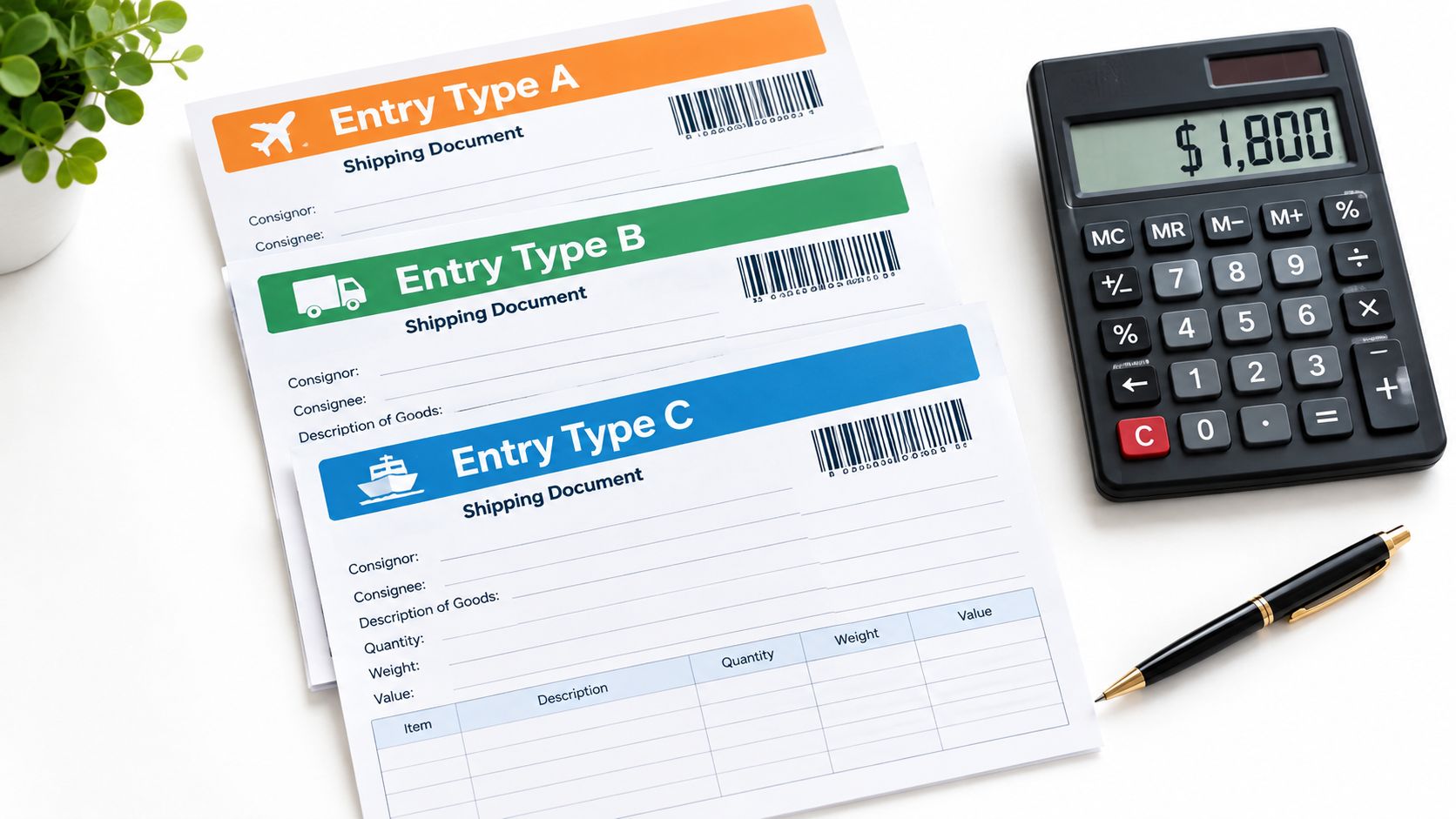
A low-value consumer goods shipment
A consumer goods shipment valued at $1,800 may be processed as an informal entry. If the applicable filing method carries the $8.06 informal MPF amount, the government fee is $8.06, with no manual surcharge when the importer uses the relevant electronic process.
The important point isn’t the multiplication. It is confirming that CBP has accepted the informal treatment and that the broker hasn’t applied a formal-entry minimum by mistake.
An industrial components entry
A formal industrial components entry valued at $15,000 produces:
$15,000 × 0.003464 = $51.96
Because that result sits between the fiscal-year limits, the MPF is $51.96. If the same merchandise were correctly declared at $12,000, the raw calculation would be:
$12,000 × 0.003464 = $41.568
Rounded to the cent, the fee would be $41.57. The difference comes from the entered merchandise value, not from the duty amount.
A high-value apparel shipment
A formal apparel shipment valued at $250,000 produces a raw MPF calculation of $866.00. The fiscal year 2026 ceiling limits the charge to $651.50.
If the same goods are legitimately divided into two formal entries of $125,000 each, each entry produces a raw MPF of $433.00, for a combined MPF of $866.00. The shipment has therefore moved from one capped entry to two uncapped entries, increasing the total fee.
The filing decision should follow the commercial and customs reality. Consolidating entries can reduce MPF when a single entry reaches the ceiling, but artificial splitting, inaccurate valuation, or unsupported documentation creates a compliance risk that no fee saving justifies.
Exemptions, Refunds, and Common Misconceptions
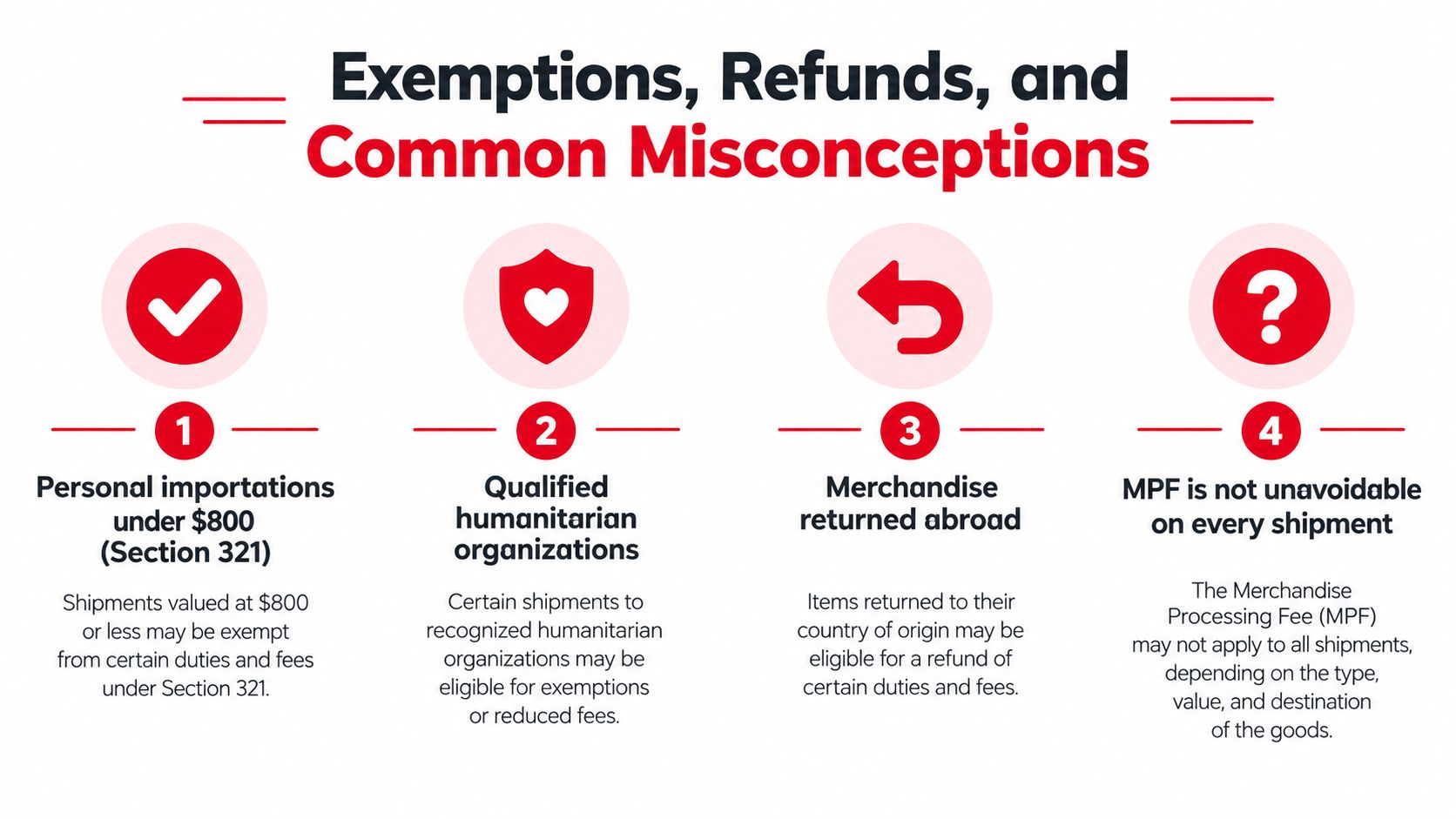
MPF isn’t automatically unavoidable in every customs scenario, but exemptions and refunds are narrower than many importers assume. Eligibility depends on the shipment’s purpose, origin treatment, documentation, and the precise customs program used.
The safest approach is to verify the program before filing rather than asking the broker to remove the fee after release. A preference claim needs supporting origin and transaction records, and an exemption from MPF doesn’t necessarily remove every other customs or transport-related charge.
Situations that deserve a document review
Importers commonly investigate these categories:
- Personal importations: Certain low-value personal shipments may qualify for a different customs treatment.
- Returning goods: Qualified U.S. returning goods may receive treatment that affects the applicable charges.
- Government and diplomatic cargo: Specific official shipments can follow special entry rules.
- Trade agreement goods: Qualifying goods under certain free trade agreements may receive MPF treatment different from ordinary formal entries.
- Unaccepted or cancelled entries: A tendered entry that isn’t accepted, or goods exported without delivery, may create a basis for reviewing whether a refund procedure applies.
A refund isn’t automatic because a shipment was delayed, returned, or entered incorrectly. The importer needs the right evidence, the correct filing procedure, and a timely claim.
Common errors in fee reviews
MPF is not a percentage of duties owed. It is tied to entered merchandise value for formal entries. It also isn’t calculated the same way for informal entries, where CBP applies the relevant flat amount.
Importers should also separate MPF from the Harbor Maintenance Fee and from broker disbursement charges. Treating all three as one generic customs cost makes it harder to verify eligibility, recover an error, or forecast the next shipment accurately.
Practical Tips to Control MPF Costs
MPF control starts before the shipment reaches the port. The objective isn’t to force every shipment into the cheapest apparent category. The objective is to submit accurate data, use the permitted entry treatment, and avoid paying for a filing structure that the transaction doesn’t require.
Build the review into shipment preparation
A useful pre-arrival checklist includes:
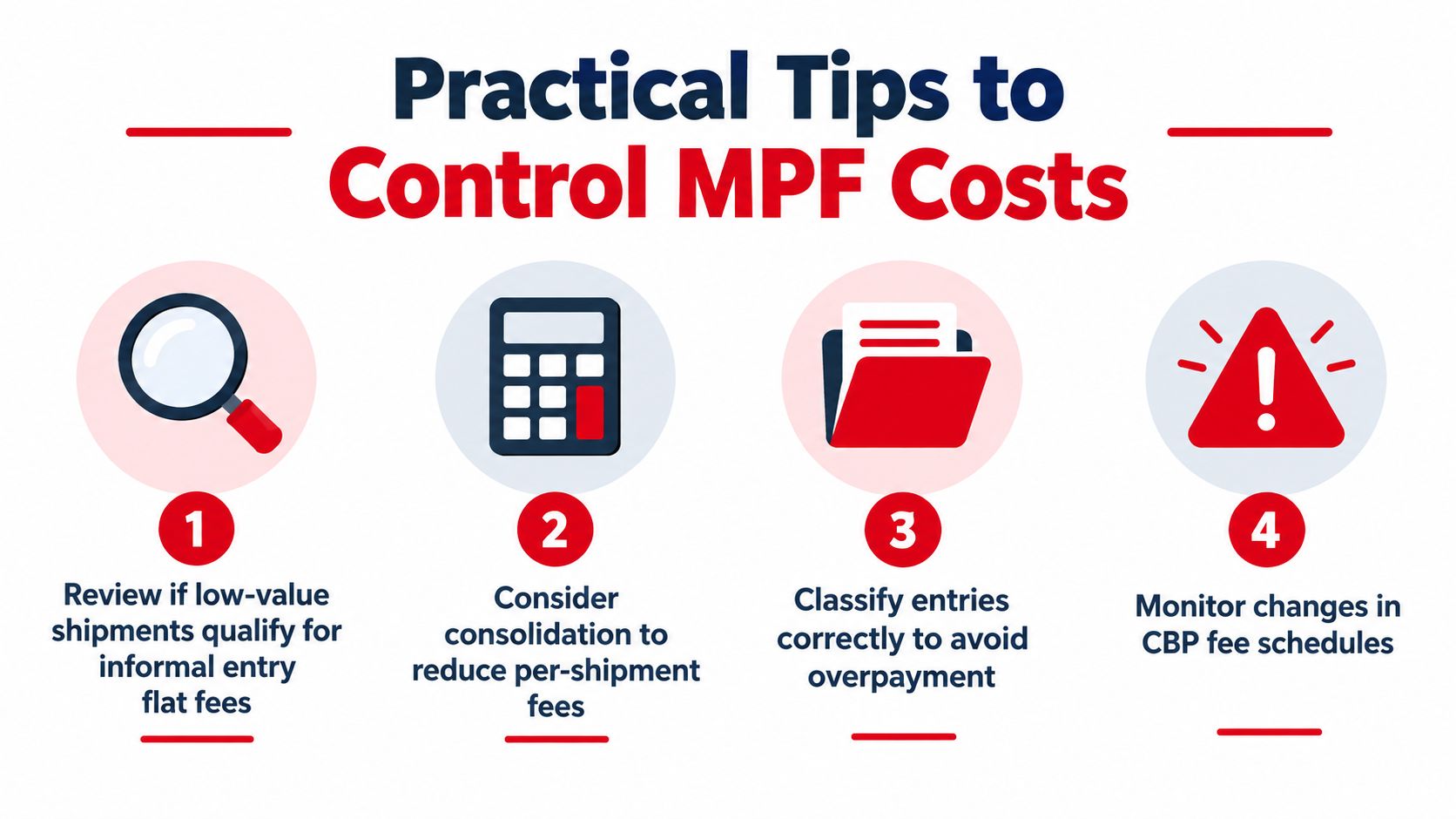
- Review low-value shipments: Ask whether the shipment qualifies for an informal entry and identify which flat amount matches the filing method.
- Model consolidation: Compare one legitimate formal entry with multiple entries, especially when the combined value approaches the ceiling.
- Check the value base: Confirm that the customs value excludes duty, freight, and insurance, and that the commercial invoice supports the declared amount.
- Choose electronic payment: Avoid the manual-processing surcharge when an approved electronic payment route is available.
- Monitor annual adjustments: Recheck CBP’s current floor, ceiling, informal amounts, and payment rules each fiscal year.
Consolidation works only when it matches the commercial movement and customs documentation. It doesn’t mean combining unrelated transactions or delaying an entry beyond what the regulations and supply chain allow. Similarly, lowering the declared value isn’t a cost-control strategy. It is a valuation problem.
Rejected entries create a second layer of work. The importer may need to correct the invoice, classification, origin evidence, or valuation support, then coordinate a refund or re-filing process. A pre-clearance document check is usually more useful than trying to recover a charge after the cargo has moved.
A freight forwarder or customs specialist can review the entry type, merchandise value, payment route, and supporting documents before filing. Novocargo provides international sea, air, and land transport coordination together with foreign trade consulting and customs documentation support, as described in its overview of logistics operator functions in international trade.
Novocargo can coordinate sea, air, and land shipments while helping importers organize customs documentation, entry details, and foreign trade requirements. Visit Novocargo to discuss a shipment review that checks entry type, declared value, filing method, and the applicable merchandise processing fee before the customs statement arrives.


- 1Merchandise Processing Fee: A ...
16 October 2026
 2Carga Consolidada: Qué es y Có...
25 July 2026
 3Hub Logístico: Qué es y por qu...
17 July 2026
en concreto?
Comentarios (0)
No hay comentarios todavía. ¡Se el primero!