




Managed Transportation Services: A Complete Explainer
07 October 2026
A shipment can be perfectly planned on paper and still become expensive after it leaves the warehouse. An apparel exporter in Vietnam may book ocean space to North America, arrange inland drayage at the destination port, send urgent replenishment by air, and use road carriers for final delivery. If each carrier, forwarder, and customs broker works from a different spreadsheet, a small schedule change can turn into missed handovers, duplicated updates, storage charges, or an invoice nobody can reconcile.
Managed transportation services address that coordination problem. They place planning, carrier management, shipment execution, visibility, exception handling, and freight controls under one accountable operating model. For exporters, the value is not just about finding transport capacity. It’s making hundreds of connected decisions behave like one network.
Table of Contents
- The Fragmented Freight Problem Most Exporters Know Too Well
- What Managed Transportation Services Actually Mean
- TMS-Led vs Broker-Led Service Models Compared
- Core Benefits and the KPIs That Prove They Work
- How Managed Transportation Providers Operate Day to Day
- Managed Transportation Services vs Traditional Freight Forwarding
- How to Choose and Evaluate a Managed Transportation Provider
- Putting Managed Transportation to Work in Your Network
The Fragmented Freight Problem Most Exporters Know Too Well
Consider a mid-sized apparel exporter shipping finished goods from Vietnam to North America. One pallet leaves the factory by truck, moves through a consolidation point, waits for an ocean departure, clears customs, and continues by road to a distribution center. A second shipment uses air freight because a retailer has brought forward a launch. A third moves through a different port because the original sailing has been rolled.
The exporter may have three ocean or air carriers, two forwarders, a drayage provider, and a customs broker involved in those moves. Each party has useful information, but no party sees the complete operating picture. The forwarder knows the booking status. The broker knows whether documents are ready. The trucker knows whether a container has been collected. The exporter has to assemble the story.
That work usually lands in email threads, rate sheets, shared spreadsheets, and phone calls. A carrier change may not reach the customs team in time. A revised arrival date may not reach the warehouse. A missed appointment can create a second delivery attempt, while an accessorial charge arrives weeks later without enough context to challenge it.
The real problem is coordination
The pallet itself isn’t the only thing moving. Bookings, commercial invoices, packing lists, customs entries, delivery appointments, carrier tenders, and payment records move alongside it. When those information flows remain disconnected, the exporter loses time investigating events instead of managing them.
A forwarding transaction can solve an individual shipment. It doesn’t automatically create a repeatable control layer across lanes, modes, and carriers. Managed transportation adds that layer by coordinating the network as an operating system rather than treating every shipment as a separate conversation.
Practical rule: If a team needs several people to answer where a shipment is, who owns the next action, or why the final invoice changed, the network has an orchestration problem.
This distinction matters because the exporter may not need more carrier options. It may need someone to decide when ocean is suitable, when air is justified, how inland legs connect to port schedules, which carrier receives the tender, and what happens when the original plan fails.
What Managed Transportation Services Actually Mean
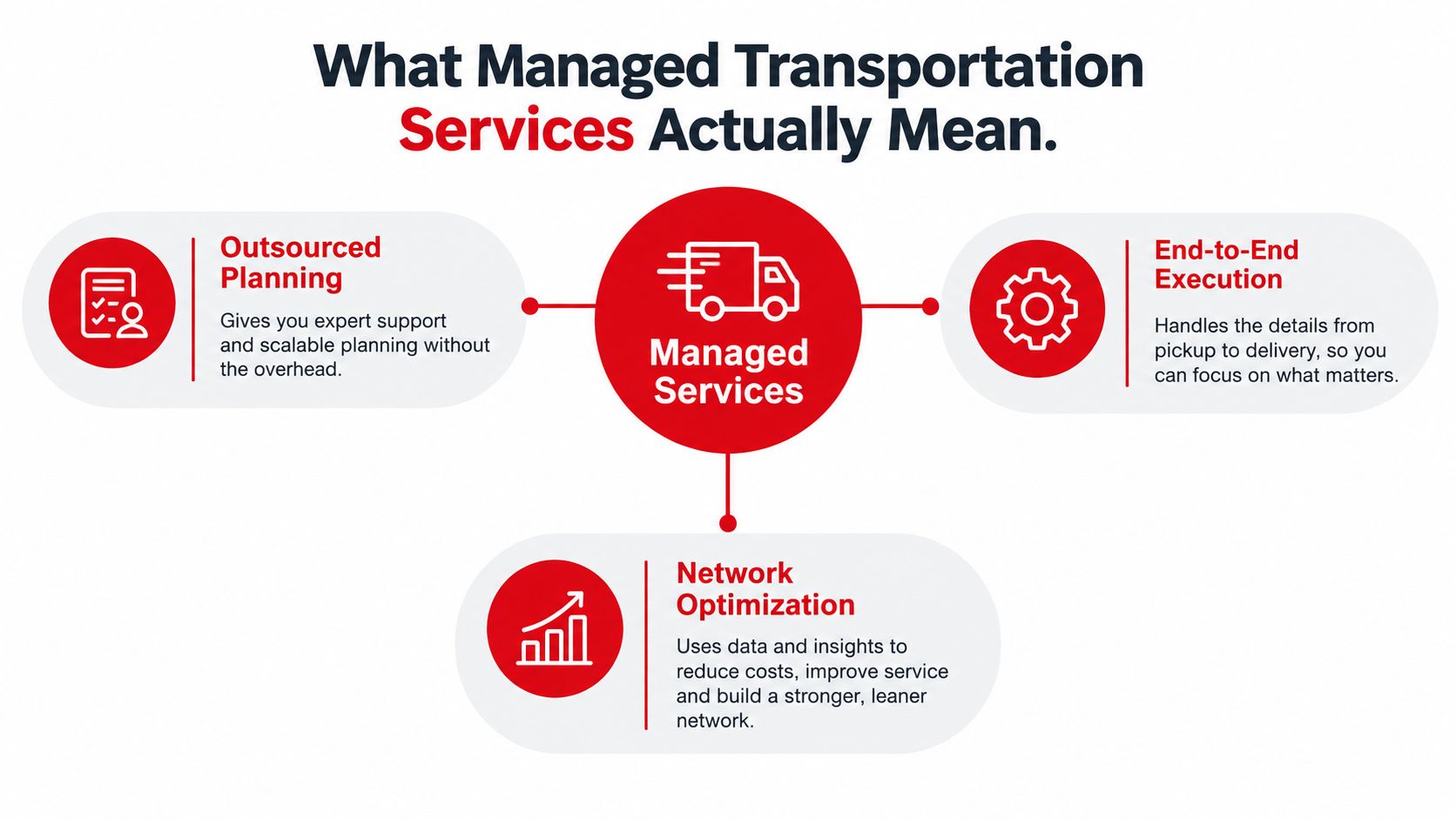
Managed transportation services are an outsourced freight operating model. A third-party provider plans the shipper’s transportation, sources and tenders capacity, books loads, tracks execution, manages exceptions, audits invoices, and reports performance. The provider supplies not only technology, but also the people and operating discipline needed to use it.
That differs from buying a transportation management system, or TMS, alone. A TMS can store rates, automate workflows, and display shipment events, but the shipper still has to configure the system, manage carriers, resolve exceptions, and act on the information. Managed transportation transfers those operational responsibilities to the provider while leaving the shipper in control of commercial priorities and service requirements.
Think of the provider as a conductor
An orchestra can have excellent musicians and still sound disorganized without timing and direction. Managed transportation works in a similar way. Ocean carriers, airlines, trucking companies, rail operators, customs specialists, warehouses, and internal teams each perform a specific role. The managed transportation provider coordinates when each party acts and provides a common view of the result.
The provider’s responsibilities typically include:
- Planning: Translating demand forecasts, order priorities, shipment characteristics, and delivery windows into transport plans.
- Carrier management: Maintaining carrier relationships, negotiating or managing rates, issuing tenders, and covering rejected or failed tenders.
- Execution: Booking capacity, monitoring milestones, and coordinating handovers across sea, air, road, and rail.
- Control: Handling disruptions, reviewing accessorials, auditing invoices, and producing performance reports.
The shipper still sets the business rules. It decides which customers receive priority, what service levels matter, which products require special handling, and which exceptions require approval. The provider turns those rules into daily decisions.
The model has become strategically significant because the managed transportation market was valued at $48.7 billion in 2025 and is projected to reach $97.4 billion by 2034, with an 8.0% compound annual growth rate, according to DataIntelo’s managed transportation services market study. Freight management represented 38.4% of the market in 2025, which reflects the central role of planning and execution in the service.
TMS-Led vs Broker-Led Service Models Compared
Two providers can use the same “managed transportation” label while offering very different operating models. The key question is who owns the technology, who controls execution, and whether the shipper is buying a managed operating process or mainly buying access to a carrier network.
A TMS-led model places the transportation management platform at the center. The provider operates the technology, maintains rate and carrier data, manages workflows, and often controls day-to-day tendering and exception resolution. This approach suits exporters that need detailed integration with enterprise resource planning, warehouse, order, customs, and finance systems.
A broker-led model relies more heavily on a trading desk and a broad network of transport providers. It can give a shipper flexible access to capacity, especially when lanes change or contracted capacity is limited. The broker manages the transaction, but technology ownership, data depth, and process consistency can vary by provider.
| Dimension | TMS-Led Model | Broker-Led Model |
|---|---|---|
| Technology ownership | Provider-operated TMS with structured workflows and reporting | Technology may support the brokerage desk, with less standardized shipper access |
| Day-to-day execution | Provider manages tenders, bookings, milestones, and exceptions | Broker arranges capacity and manages shipment transactions |
| Cost transparency | Lane, carrier, tender, and accessorial data can be separated for analysis | Pricing may be easier to obtain quickly, but underlying cost detail can vary |
| Scalability | Strong fit for repeatable multi-lane and multimodal programs | Strong fit for flexible capacity and changing shipment requirements |
| Customization | Workflows can be configured around service rules and integrations | Customization often depends on the desk, network, and shipment type |
| Best fit | Exporters seeking sustained control, reporting, and optimization | Exporters prioritizing rapid capacity access and transactional flexibility |
A TMS-led provider can require more disciplined onboarding because master data, integrations, and operating rules need to be accurate. A broker-led model can start faster, but the exporter should test how it will receive status data, compare carrier performance, and audit charges over time.
A useful TMS supply chain improvement guide can help a shipper identify which workflows need technology and which require an operating team. The right choice depends less on the label and more on the level of accountability the exporter expects.
Core Benefits and the KPIs That Prove They Work
The strongest managed transportation programs connect each promised benefit to an observable measure. Cost control isn’t proved by a polished dashboard. It appears in freight cost per unit, spend under management, invoice accuracy, and the speed with which teams identify leakage.
Managed transportation services can produce 5% to 15% freight-spend savings through consolidation, automated mode and carrier selection, optimized loading, and reduced empty miles, according to Descartes’ transportation management savings analysis. The same source reports that 32% of surveyed shippers achieved freight-cost reductions above 12%. Those results point to a broader lesson: negotiation alone isn’t the full program. Network design and execution controls determine whether savings survive daily operations.
Four benefits with operating evidence
Network consolidation reduces unnecessary fragmentation. A provider can compare lanes, equipment requirements, shipment timing, and carrier performance across the entire program rather than treating each booking as an isolated decision. The relevant measures include freight cost per unit, percentage of spend under management, tender acceptance ratio, and the number of active carrier relationships by lane.
Visibility gives the exporter one version of shipment status. This matters when an ocean arrival changes, an air shipment misses a connection, or a road carrier reports a delivery exception. Real-time transportation visibility was cited by 42% of respondents as the top must-have capability for effective transportation management for the seventh consecutive year, according to SupplyChainBrain’s coverage of the transportation-management benchmark. Useful KPIs include on-time delivery rate, milestone completeness, and exception-to-resolution time.
Compliance control connects shipment execution to customs documentation and audit-ready records. Teams should measure invoice accuracy, document completeness, customs exception frequency, and the time required to produce evidence for an audit. A provider that tracks only transit time can miss the financial and regulatory consequences of poor documentation.
Service reliability turns operational consistency into a customer-facing result. Tender acceptance, delivery performance, failed appointment rates, and unresolved exceptions reveal whether the provider is managing the network or merely forwarding updates.
| Core Benefit | Primary KPI | What Good Looks Like |
|---|---|---|
| Cost control | Freight cost per unit | Costs are compared by lane, mode, product, and service requirement |
| Network consolidation | Percentage of spend under management | The reporting scope covers the lanes and carriers that materially affect the program |
| Capacity management | Tender acceptance ratio | Rejected tenders trigger a defined fallback process |
| Visibility | On-time delivery rate | Milestones are visible across the relevant transport legs |
| Financial control | Invoice accuracy | Charges are checked against contracted rates and approved accessorials |
| Exception management | Exception-to-resolution time | Ownership and escalation paths are clear |
A shipper can use logistics KPI guidance to build a baseline before selecting a provider. Without a baseline, a vendor can claim improvement using a narrower scope, a different period, or a favorable lane mix.
How Managed Transportation Providers Operate Day to Day
A managed transportation provider operates like an air-traffic controller coordinating multiple runways. The provider doesn’t own every aircraft, truck, vessel, or rail service. It sequences movements, checks constraints, redirects traffic when conditions change, and keeps each participant working from the same operating plan.
The daily workflow begins before a shipment exists. Forecasts, purchase orders, inventory positions, customer commitments, product characteristics, and delivery windows help determine which transport option fits the business requirement.
From planning to booking
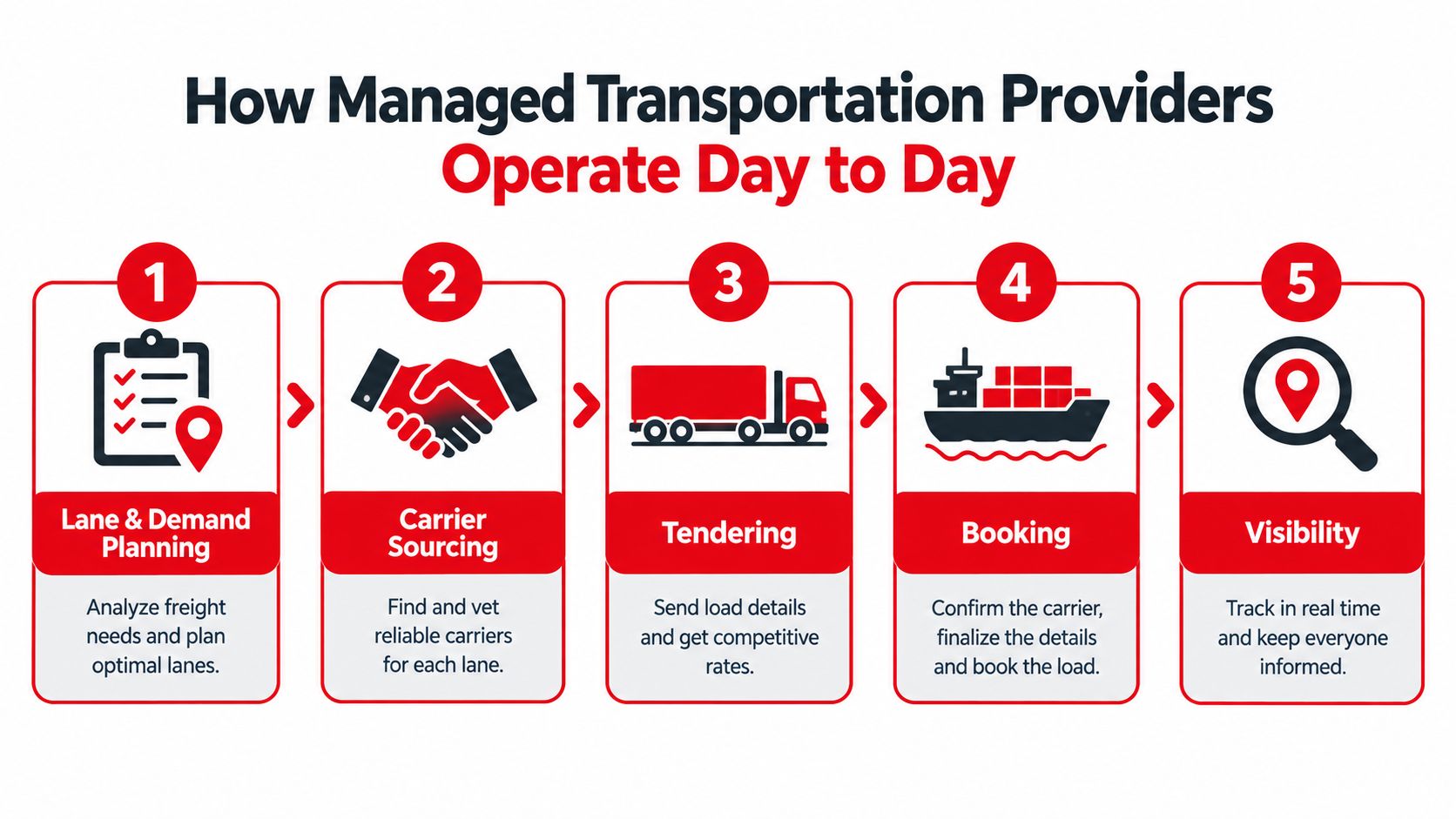
Lane and demand planning establishes expected volumes and constraints. An exporter might identify regular ocean flows, seasonal air requirements, inland delivery patterns, and products that need special documentation.
Carrier sourcing matches those lanes with suitable carriers and equipment. The provider may use contracted capacity, a mini-bid, or a spot process when the network changes.
Tendering sends the load to the selected carrier and manages the response. If a carrier rejects the tender, the provider follows an agreed fallback sequence rather than leaving the shipper to restart the search.
Booking confirms space, equipment, collection, and delivery details across the relevant mode. A multimodal move requires more than separate bookings. It requires handover timing, document consistency, and escalation ownership.
Visibility and exception handling track milestones and trigger action when the plan breaks. The provider may rebook, change a routing, alert a warehouse, or ask the shipper to approve a service trade-off.
For teams that need a practical reference for maintaining the physical side of logistics operations, the Forge Reliability logistics guide offers useful context on logistics equipment and reliability considerations.
The final stage is settlement. The provider checks freight invoices against rates, shipment records, accessorial approvals, and delivery evidence, then reports results to the shipper. The exporter remains responsible for demand information, commercial priorities, product data, and approval thresholds. The provider owns the operating cadence and the follow-through.
A short visual overview can reinforce how these moving parts connect:
Managed Transportation Services vs Traditional Freight Forwarding
Traditional freight forwarding and managed transportation services overlap, but they solve different problems. A forwarder arranges and executes transport for a shipment. A managed transportation provider governs the shipper’s broader freight program, including the rules used to select, monitor, measure, and improve transport across repeated movements.
A forwarder may be the right specialist for an unusual oversized export, a one-off air shipment, a difficult origin, or a route where local expertise matters most. The forwarder handles documentation, carrier coordination, customs support, and shipment execution. The relationship often centers on the individual consignment.
Managed transportation focuses on the pattern behind the consignments. It examines recurring lanes, mode decisions, carrier allocation, tender performance, delivery reliability, invoice controls, and network-wide exceptions. Its success depends on creating a repeatable operating process rather than completing the next move.
| Dimension | Managed Transportation Services | Traditional Freight Forwarding |
|---|---|---|
| Primary purpose | Govern and optimize a recurring freight program | Arrange and execute individual shipments |
| Scope | Multiple lanes, carriers, modes, and business units | Shipment, route, origin, or destination assignment |
| Visibility | Shipper-level view across the managed network | Shipment-level status and documents |
| Commercial focus | Managed spend, carrier performance, and ongoing optimization | Shipment quotation and execution |
| Technology role | Central TMS, integrations, dashboards, and exception workflows | Booking and shipment systems supporting forwarding activity |
| Capacity approach | Structured carrier sourcing and tender rules | Forwarder’s carrier relationships for the shipment |
| Best fit | Steady-state volume with repeated operational complexity | One-off, specialized, or locally complex movements |
The two models can work together. A managed transportation provider may govern regular ocean, air, and road flows while a specialist forwarder handles an exceptional shipment. The important point is to define the boundary clearly. If both parties can change a booking, approve an extra charge, or contact the customer without a shared escalation process, the exporter may recreate the fragmentation it was trying to remove.
How to Choose and Evaluate a Managed Transportation Provider
Provider selection should begin with operational fit, not the lowest quoted management fee. A low rate can conceal weak milestone data, heavy subcontracting, limited customs capability, or unclear responsibility when a tender fails.
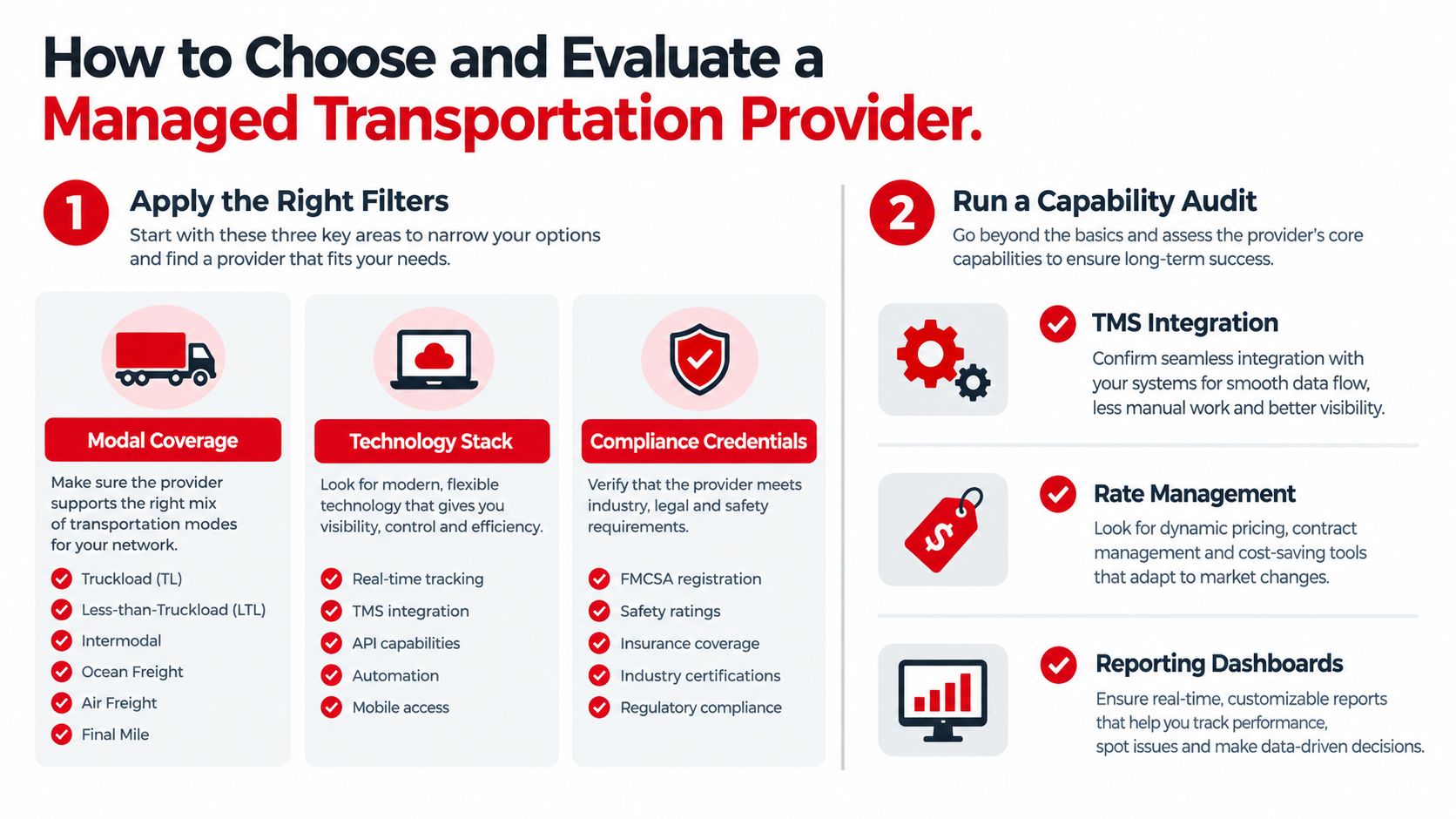
Three filters narrow the field quickly:
- Modal coverage: Confirm whether the provider can coordinate the sea, air, road, rail, drayage, warehousing, and customs activities that the network requires.
- Technology stack: Ask for a live demonstration of carrier tendering, rate management, milestone visibility, API connectivity, exception workflows, invoice audit, and reporting.
- Compliance credentials: Verify customs authorizations, insurance, financial safeguards, quality systems, data controls, and documented procedures for regulated cargo.
Turn the shortlist into an evidence test
A capability presentation isn’t enough. The exporter should ask each provider to model a real lane, including a late booking, a rejected tender, a customs-document discrepancy, and an invoice with an accessorial charge. The exercise shows whether the provider has a genuine operating playbook or only a polished interface.
The evaluation should also cover:
- Integration depth: Can the provider connect shipment, order, warehouse, finance, and customs data without creating a separate manual process?
- Carrier governance: Who negotiates rates, monitors performance, approves substitutions, and handles capacity fallout?
- Multimodal reach: Can the same control team coordinate a sea leg, an air recovery move, and road delivery?
- Service-level language: Are response times, escalation rules, reporting duties, and financial remedies specific?
- Business continuity: Can the provider maintain operations if a carrier, port, system, or local partner becomes unavailable?
A pilot gives both sides a controlled way to test the model. The exporter should define baseline KPIs from the prior operating period, establish clear exit clauses, and schedule regular business reviews. The selection process described in these provider evaluation criteria can support that due diligence.
Red flags include dependence on one mode, opaque subcontracting, vague ownership of customs work, reports that cannot be exported, and service-level agreements that describe intentions instead of measurable obligations.
Putting Managed Transportation to Work in Your Network
The first practical step is a network map, not a provider meeting. List each recurring lane, transport mode, origin, destination, carrier, forwarder, broker, handover, document requirement, and invoice path. This exposes where cost leakage, visibility gaps, and compliance risk enter the process.
Next, identify the three problems that cause the most operational damage. One exporter may struggle with missed ocean connections and port handovers. Another may have reliable transport but poor invoice controls. A healthcare shipper may care most about documented handling and regulatory consistency.
A disciplined implementation path
A provider shortlist should include two or three organizations whose modal coverage, technology, and compliance credentials match those problems. Each candidate should receive the same shipment data and the same exception scenarios, so the exporter can compare operating responses rather than marketing language.
Onboarding normally requires coordinated work across several streams:
- Data preparation: Clean lane, product, carrier, rate, customer, and location data.
- System connection: Establish the required integrations, user roles, alerts, and reporting views.
- Carrier onboarding: Confirm contracts, tender rules, contact paths, equipment requirements, and fallback options.
- KPI baselining: Agree on definitions for cost, service, visibility, compliance, invoice accuracy, and exception response.
- Operating launch: Start with an agreed scope and review exceptions closely.
- Optimization reviews: Use the first quarter of performance data to adjust routing, carrier allocation, service rules, and controls.
Novocargo is one option for exporters seeking coordinated sea, air, road, rail, logistics, distribution, and customs clearance within a multimodal operating model. Its stated credentials include ISO 9001 and ISO 14001 systems, AEO certification, GDP-aligned handling, FETEIA-approved contracting conditions, and FIATA-aligned liability insurance, which are relevant checks for shippers that need documented quality, environmental, customs, and regulated-goods processes.
The common mistakes are predictable. Chasing the lowest rate can overlook execution quality. Skipping pilot service levels leaves accountability untested. Underestimating change management causes staff and carriers to bypass the new workflow, returning the exporter to disconnected calls and spreadsheets.
Novocargo coordinates international sea, air, and land transport alongside logistics, distribution, foreign trade consulting, and customs support. Exporters evaluating managed transportation services can visit Novocargo to discuss a multimodal operating model, required compliance controls, and a practical network assessment.


 1Merchandise Processing Fee: A ...
16 October 2026
 2Carga Consolidada: Qué es y Có...
25 July 2026
 3Hub Logístico: Qué es y por qu...
17 July 2026
en concreto?
Comentarios (0)
No hay comentarios todavía. ¡Se el primero!