




Duties and Taxes in International Trade: A Practical Guide
14 October 2026
A small e-commerce founder approves a supplier’s quote for handcrafted candles, calculates a comfortable margin, and expects the shipment to arrive at roughly the quoted product cost plus freight. Instead, a customs invoice appears before the candles reach a domestic shelf. The product price was only one part of the transaction. Duty, import tax, processing fees, and transport-related charges have changed the final figure.
That surprise is common because duties and taxes are often treated as a single line item. In reality, the import bill usually contains several layers: customs duty, VAT or GST, excise where applicable, customs fees and surcharges, and freight-related costs that may affect the taxable base. Each layer follows its own rule, and the final landed cost becomes much easier to forecast once those rules are separated.
Table of Contents
- The Import Bill Most People Do Not Expect
- What Duties and Taxes Actually Are
- How HS and HTS Codes Decide the Rate
- Customs Valuation and the Dutiable Base
- Calculating Landed Cost From Factory to Door
- Mode of Transport and Shipment Structure
- Compliance Tips for Importers and Exporters
- Common Misconceptions and Where Trade Is Headed
The Import Bill Most People Do Not Expect
The supplier’s invoice answers one question: what the goods cost at the agreed point of sale. It doesn’t necessarily answer what the importer will pay to place those goods in a warehouse, shop, or fulfillment center. Customs authorities assess the shipment under legal rules that can differ from the commercial terms used by the buyer and seller.
A candle business, for example, might negotiate a favorable factory price and still discover that the shipment carries a different cost structure at the border. The customs value may include required additions, duty may apply to that value, and import VAT may then apply to a broader amount that includes duty and certain transport costs.
The five layers that shape the bill
The cost stack usually includes:
- Customs duty: A border charge based on the classification, origin, and customs value of the goods.
- VAT or GST: A consumption tax that often uses a broader base than customs duty.
- Excise: A selective charge for products such as alcohol, tobacco, or fuel, where the destination rules impose one.
- Customs fees and surcharges: Processing, inspection, harbor, brokerage, disbursement, or other charges connected with clearance.
- Freight-related costs: Transport, insurance, handling, and other amounts that may affect valuation or the total amount paid before delivery.
The distinction matters because a shipment can have a low or zero customs duty rate and still generate a meaningful import bill. The Congressional Research Service’s overview of U.S. tariff history describes the long shift from governments funded heavily by customs duties toward systems funded more by income and payroll taxes. It also notes the decline in global tariff rates after the GATT and WTO frameworks, but lower headline tariffs haven’t removed the need to account for valuation, indirect taxes, and compliance.
Practical rule: The quoted product price is an input to landed cost, not a reliable substitute for landed cost.
The first task is therefore not to ask for a single duty percentage. An importer needs to identify the product’s classification, confirm its origin, establish the legally correct customs value, determine the entry channel, and map every tax and fee that the chosen route can trigger.
What Duties and Taxes Actually Are
The easiest way to understand the cost stack is to treat each charge as a different toll on the journey from seller to buyer. Customs duty is the border toll on the goods. VAT or GST is a consumption tax, often assessed after duty and certain related charges have entered the calculation. Excise targets selected products, while ancillary fees pay for specific administrative or handling activities.
Duty is commonly calculated as an ad valorem percentage of customs value, although some tariff schedules also use specific or compound methods. The WTO Agreement on Customs Valuation establishes transaction value as the primary basis, meaning the price paid or payable for goods sold for export, adjusted according to the agreement.
VAT and GST follow a different logic. The OECD guidance on import VAT explains that imported goods are generally taxed like domestic goods and that the import VAT base commonly includes customs value, transport or ancillary costs, and duties. That structure creates a compounding effect. A duty charge can increase the base on which import VAT is calculated.
Excise works more like a targeted surcharge. A beverage, tobacco product, or fuel shipment may face an excise charge based on quantity, product characteristics, value, or a combination of methods. For those goods, the excise line can matter more than the ordinary customs duty line.
The four layers of import charges
| Charge type | What it is | Applied to | Typical range | Paid by |
|---|---|---|---|---|
| Customs duty | A border charge on imported goods | Customs value, quantity, or a tariff formula | Varies by classification and origin | Importer of record, unless the sales terms allocate the economic cost elsewhere |
| VAT or GST | A consumption tax on imported goods | Often customs value plus duty and specified costs | Varies by destination and product treatment | Importer, recipient, or seller depending on the arrangement |
| Excise | A selective tax on designated goods | Quantity, value, or product characteristics | Varies by product and jurisdiction | Usually the importer or other liable tax party |
| Customs and handling fees | Charges for clearance, processing, inspection, or transport-related services | Entry, shipment, mode, or service | Varies by authority, broker, and route | The party responsible under the contract or service terms |
Why the order matters
Suppose an importer sees a duty calculation and a VAT calculation as unrelated lines. That view can understate the total because VAT may be assessed after duty has been added. The importer also needs to distinguish recoverable input VAT from an unrecoverable cost. A registered business may recover import VAT through its local tax process, while a consumer or nonregistered entity may experience the same amount as a direct landed-cost burden.
Fees behave differently again. A customs user fee may be tied to the entry, while a carrier handling charge may depend on the selected transport channel. The final bill isn’t determined by the tariff rate alone.
How HS and HTS Codes Decide the Rate
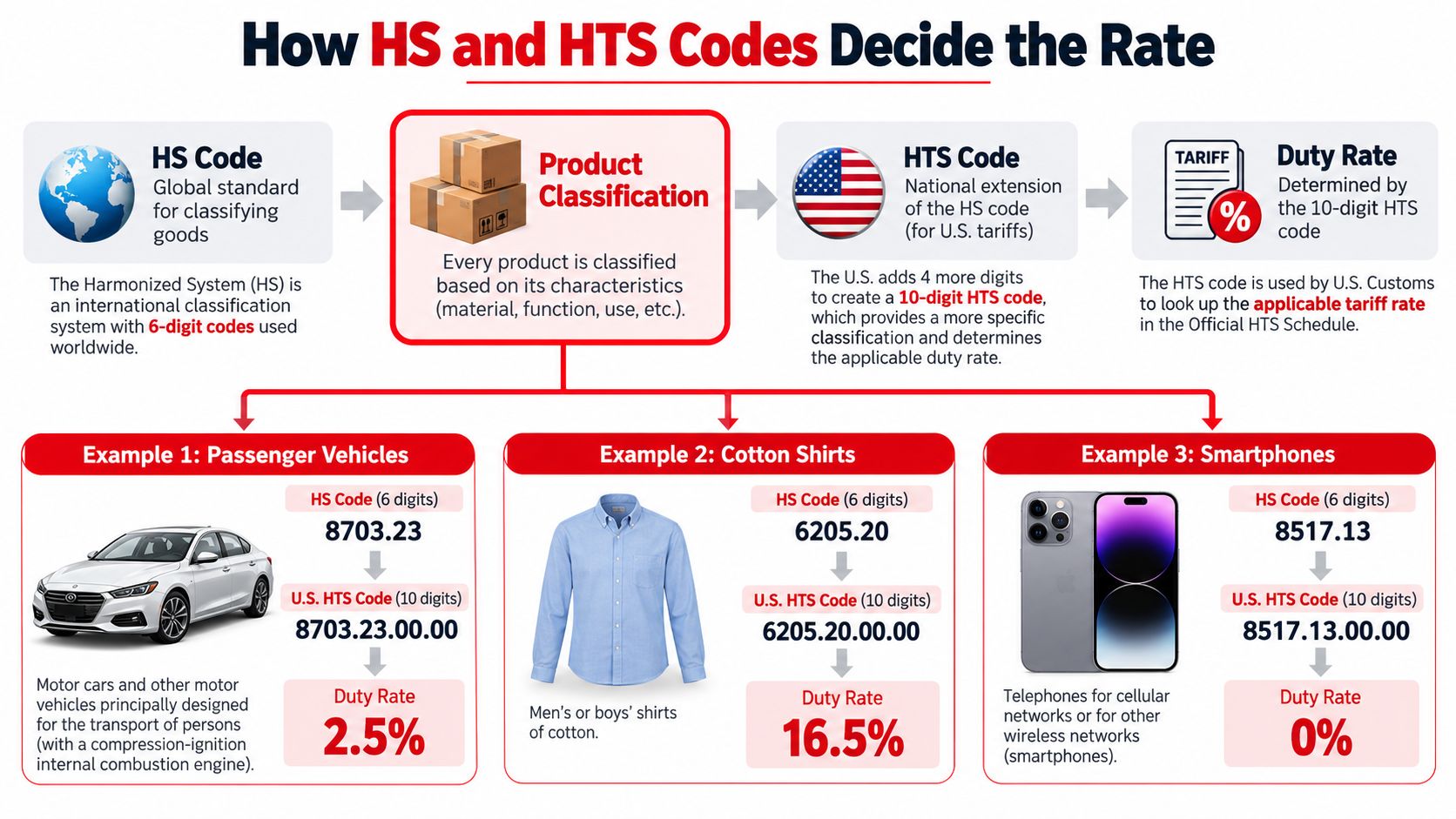
The Harmonized System gives customs authorities a shared product language. Its international structure uses a six-digit code, while national tariff schedules extend that structure with additional digits. In the United States, the Harmonized Tariff Schedule adds national detail, but other jurisdictions apply their own extensions and measures.
Classification begins with the product itself, not the supplier’s preferred description. Material, function, construction, composition, degree of processing, and intended use can all influence the result. A plastic kitchen implement and a plastic toy may look similar in a warehouse, yet their legal tariff headings can differ because customs treats function and product identity as decisive.
The same principle applies to clothing. A knitted garment’s construction, fiber content, and design can place it in a different tariff heading from another garment that looks similar in a product catalog. A single digit in a national tariff extension may change the applicable duty treatment, licensing requirements, marking obligations, or eligibility for a preference.
Classification is a legal decision
An importer can ask a supplier or broker for a proposed code, but the importer of record remains responsible for the declaration. A broker can prepare and transmit an entry, yet that service doesn’t transfer the underlying legal responsibility for accurate classification and valuation.
The General Rules of Interpretation provide the framework for resolving classification questions. Customs authorities may also issue binding or advance rulings, allowing an importer to obtain a formal position before a recurring shipment program begins.
A sound classification file should contain:
- Product specifications: Composition, dimensions, technical function, and construction details.
- Commercial evidence: Catalog pages, photographs, engineering drawings, and supplier descriptions.
- Competing headings: The reasons alternative classifications were rejected.
- Origin analysis: The manufacturing facts needed for the applicable tariff treatment.
- Ruling support: Any binding decision or written customs opinion that applies to the product.
Classification should be settled before pricing is approved. A tariff code selected after the sale can turn a profitable quote into an underpriced order.
The largest risks often arise when a business classifies an entire product family under one convenient heading. Closely related products may need separate analysis, especially where materials, functions, or assembly methods differ.
Customs Valuation and the Dutiable Base
Customs duty usually applies to a legally defined customs value, not automatically to every figure printed on a commercial invoice. Under the WTO framework, transaction value is the starting point. The importer begins with the price paid or payable and then reviews additions and deductions required by the applicable valuation rules.
Potential additions include packing supplied by the buyer, assists such as tools or materials provided to the manufacturer, qualifying royalties or license fees, and proceeds that return to the seller. Potential exclusions or deductions can include certain international freight, insurance, or post-importation costs, but the treatment depends on the governing rules and the evidence available.
That distinction makes valuation a documentation exercise as much as a mathematical one. A royalty clause buried in a technology agreement, an injection mold paid for by the buyer, or design work supplied without charge can affect the customs value even when the commercial invoice doesn’t show those items as part of the product price.
For readers who need a broader explanation of how a tax base works across different contexts, this tax base explained for landlords guide offers useful background. Customs valuation is more specialized, but the central idea is similar: the legal base determines which rate is applied and which costs enter the calculation.
Transaction value adjustments at a glance
| Item | Treatment | Example on a $10,000 invoice |
|---|---|---|
| Invoice price | Starting point for transaction value, subject to the valuation rules | Starts with $10,000 |
| Packing | May be added when the buyer provides or pays for qualifying packing | Review whether the packing cost is already included |
| Assists | May be added when the buyer supplies qualifying materials, tools, or services | Add the supported dutiable portion where required |
| Royalties | May be added when the payment relates to the imported goods and is a condition of sale | Examine the contract and payment flow |
| International freight and insurance | May be treated according to the destination’s valuation rules and the entry terms | Separate documented transport elements from the goods price |
| Post-importation services | May be excluded when separately identified and legally deductible | Keep contracts and invoices showing the separation |
The invoice isn’t the whole file
An importer should reconcile the invoice with purchase orders, payment records, tooling agreements, development contracts, freight documents, and assists provided to the factory. Customs authorities can reassess entries after release when later information shows that the original value was incomplete.
Undervaluation isn’t a harmless shortcut. It can lead to additional duty, tax, interest, penalties, and a more intensive review of later shipments. Accurate valuation also supports consistent pricing because the business can see which costs are fixed, negotiable, recoverable, or exposed to policy changes.
Calculating Landed Cost From Factory to Door
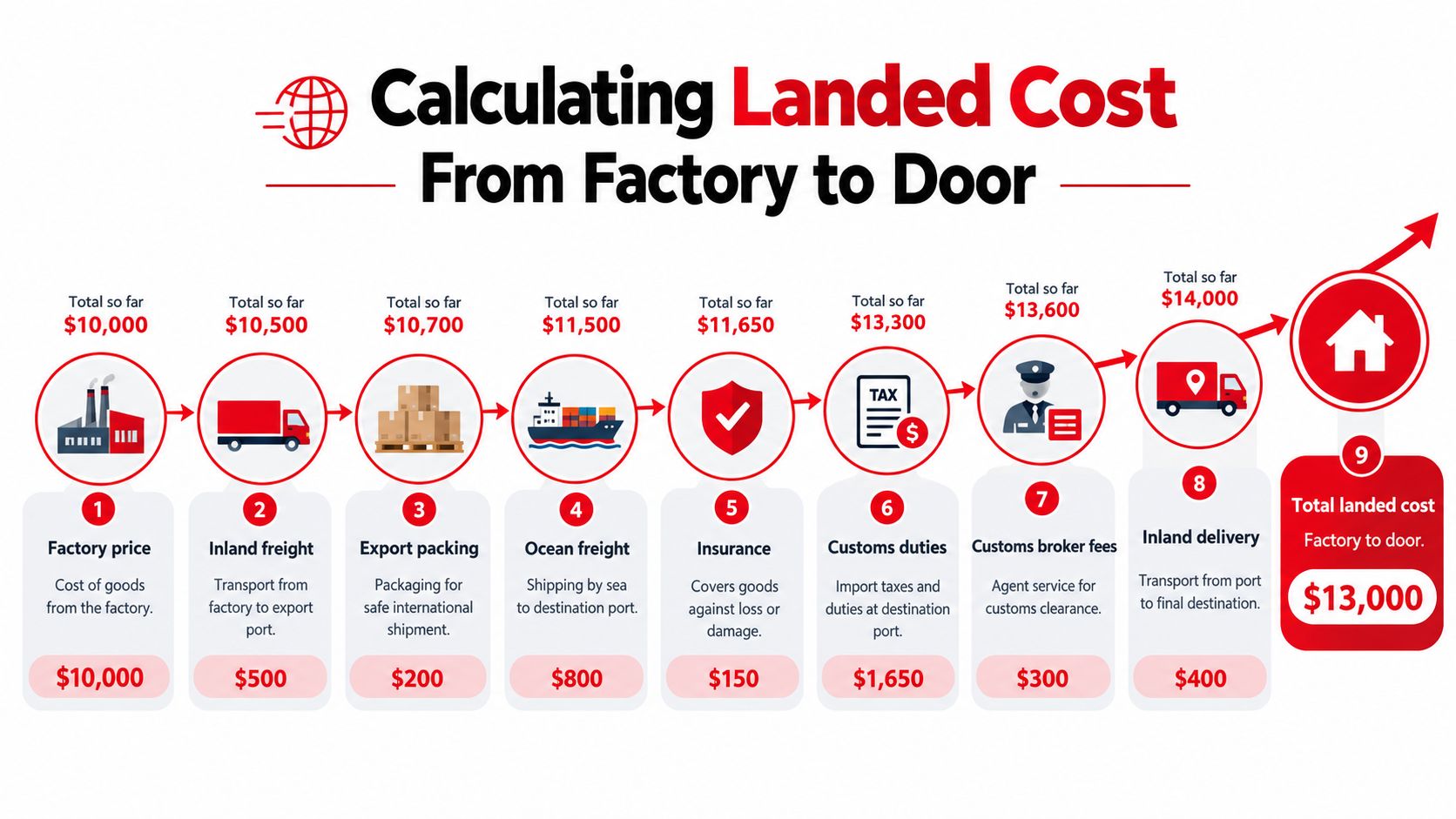
A useful landed-cost model starts before the goods leave the supplier. The model should separate the factory price from inland movement, export preparation, international transport, insurance, customs charges, taxes, brokerage, and final delivery. It should also label each amount according to who controls it.
A supplier may negotiate the product price and packing terms. A carrier sets transport charges according to the route and shipment structure. Customs authorities determine duty and tax under the applicable classification, valuation, origin, and entry rules. A broker or forwarder may charge service fees that vary by scope and mode.
The process can be represented as:
Factory price + origin costs + international freight and insurance = the starting import value.
Starting import value + applicable duty and fees = the duty-inclusive import cost.
Duty-inclusive import cost plus the relevant VAT base and delivery charges = the delivered landed cost.
A reusable calculation method
An importer can build the worksheet in this order:
- Record the supplier’s product price and the agreed Incoterm.
- Add origin handling, inland transport, and export packing where the buyer bears those costs.
- Add international freight and cargo insurance.
- Establish which of those amounts belong in customs value under the destination rules.
- Apply the correct duty method to the resulting dutiable base.
- Add customs processing, broker, inspection, harbor, or other route-specific fees.
- Determine the VAT or GST base, including duty and any legally required additions.
- Add destination delivery, storage, and handling costs.
- Divide the total by units, weight, or another commercial measure used for pricing.
A business shouldn’t assume that every amount belongs in the customs value or that every tax is recoverable. The worksheet needs separate columns for customs value, nonrecoverable cost, recoverable tax, and cash paid at clearance.
The distinction between tax-inclusive and tax-exclusive pricing can also change how a quote is interpreted. A practical explanation of exclusive versus inclusive VAT helps clarify why a displayed price may or may not contain the tax amount.
Shipment planning should also account for the physical goods and the agent coordinating their movement. Information about goods in logistics and the freight agent can help an importer identify where transport coordination ends and customs responsibility begins.
The embedded video provides another visual way to follow a landed-cost calculation:
Mode of Transport and Shipment Structure
Transport mode changes more than transit time. It can change the fee set, the clearance channel, the party collecting payment, and the way freight enters the valuation analysis. Ocean cargo may involve port, terminal, container, harbor, storage, and examination charges. Air cargo often moves through an express or freight handling network with different brokerage and security fees. Road shipments can involve border processing, transit documents, and destination delivery arrangements.
Shipment structure matters just as much. A full container, a less-than-container-load shipment, a courier parcel, and a postal consignment can carry the same product under very different administrative processes. An importer comparing only the supplier price and the nominal duty rate is comparing incomplete scenarios.
The entry channel changes the economics
A formal entry generally requires more detailed documentation and may attract structured customs processing costs. An informal or simplified entry can reduce administrative work but may have different limits and payment arrangements. Low-value channels may benefit from local de minimis rules, but those rules differ by jurisdiction, product, tax, and transport channel.
The U.S. Customs and Border Protection guidance on duties, taxes, and fees by shipment type explains that additional charges depend on the commodity, entry type, and transport mode. It also distinguishes ocean-specific charges from fees associated with informal mail entries. The lesson is practical: the same item can produce a different total depending on how it enters.
| Mode or entry type | Typical fees | De minimis impact | Who pays |
|---|---|---|---|
| Ocean container | Port, terminal, broker, storage, inspection, and possible harbor-related charges | Depends on the entry and destination rules | Contractually allocated, with the importer often responsible for clearance |
| Consolidated ocean cargo | Consolidation, deconsolidation, handling, delivery, and brokerage charges | A low-value threshold may not remove consolidation or handling costs | Buyer, seller, or forwarder according to the arrangement |
| Air freight | Airline, security, handling, brokerage, and delivery charges | Low-value treatment may apply, but carrier fees can remain | Importer, recipient, or seller depending on the service |
| Courier parcel | Courier clearance, disbursement, and delivery fees | Channel-specific rules can apply | Often advanced by the courier and billed to the liable party |
| Postal or simplified entry | Postal handling and applicable flat or simplified charges | May use a distinct low-value process | Recipient, sender, or tax intermediary |
The international container freight service page provides useful context for how containerized transport fits into broader logistics planning. A route decision should compare the complete cost stack, not just the freight quotation.
In 2026, the European Union’s planned €3 nonrefundable duty per low-value parcel line item under €150, starting July 1, 2026, makes line-item planning especially important, as described in the verified customs guidance provided for this topic. A seller shipping a mixed parcel therefore needs to consider product lines, channel, and tax responsibility rather than relying on a generic country estimate.
Compliance Tips for Importers and Exporters
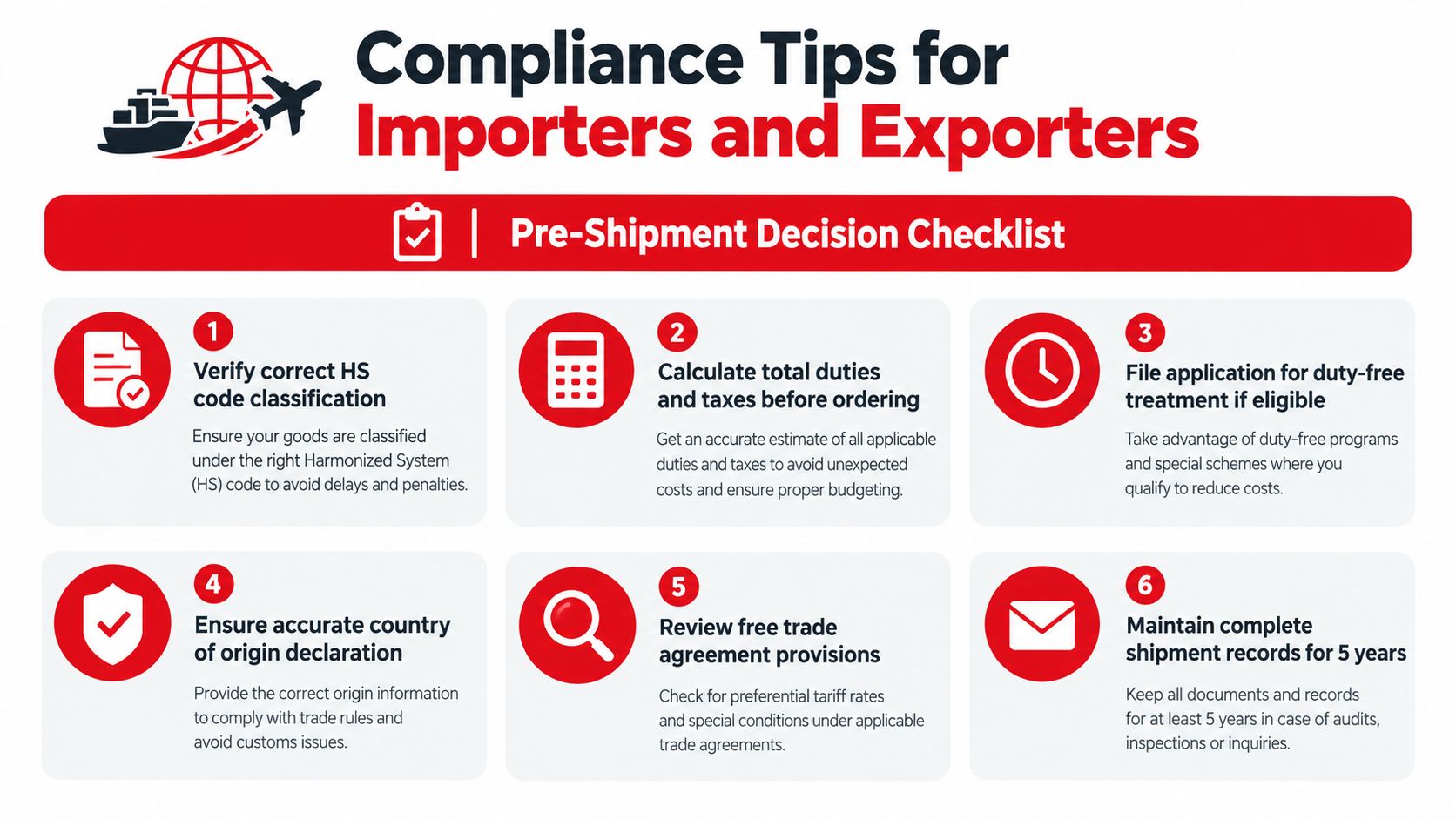
A pre-shipment review prevents more problems than a post-entry correction. The importer should treat classification, valuation, origin, documentation, and tax responsibility as commercial decisions that need approval before goods move.
The pre-shipment checklist
- Confirm the HS classification: Match the code to product specifications, composition, function, and construction. Seek a binding or advance ruling when the classification has material financial or regulatory consequences.
- Document the origin: Verify where the product meets the applicable origin rule, not merely where the final box was shipped from. Review preference eligibility before claiming an agreement benefit.
- Reconcile customs value: Compare the commercial invoice with purchase orders, assists, tooling, royalties, commissions, freight terms, and payment records.
- Prepare the entry file: Keep the commercial invoice, packing list, transport document, origin evidence, licenses, permits, and product-specific certificates together.
- Assign tax responsibility: Identify the importer of record and determine who will pay duty, VAT or GST, excise, brokerage, and destination charges under the sales and transport terms.
- Set a retention process: Preserve the supporting records for the period required by the destination jurisdiction and the company’s compliance policy.
The international transport and customs service overview can help businesses understand how transport coordination and customs procedures connect, but professional advice should still be adjusted to the product and destination.
Importers remain responsible even when a broker submits the declaration. A broker audit can test whether the supplier’s descriptions, classification decisions, valuation method, and origin claims remain accurate across the product range.
Exporters should also review whether components can qualify for duty drawback or another recovery mechanism when goods are later exported or re-exported. That review requires transaction-level records and a clear link between imported inputs and exported products.
A clean shipment is rarely the result of one clever tariff decision. It usually comes from a small set of accurate decisions made early, supported by documents that tell the same story.
Common Misconceptions and Where Trade Is Headed
Myth one: DDP removes every surprise. Delivered Duty Paid can allocate more transport and import responsibilities to the seller, but the commercial quote still needs to show what has been included, what assumptions were used, and who remains liable if customs rejects a classification or valuation. A vague DDP quote can hide risk rather than remove it.
Myth two: A low-value parcel is always duty-free. Low-value treatment depends on the destination, product, tax, entry type, and channel. Customs fees, courier disbursement, VAT, or new parcel charges may still apply even when ordinary duty treatment is reduced.
Myth three: A lower declared value always lowers the bill. Customs valuation rules can require additions beyond the invoice line, including qualifying assists or royalties. An unsupported reduction can create reassessment and penalty exposure rather than a dependable saving.
Myth four: Duty is only lost margin. Duty can affect sourcing, product design, packaging, route selection, customer pricing, and the choice between a local and cross-border fulfillment model. The cost is commercial information, not merely an accounting deduction.
Policy is becoming more route-specific
The United States announced a temporary 10% import surcharge for 150 days in 2026, according to the White House import surcharge announcement. That policy shift illustrates why a quote can become exposed while goods are in transit or while a sales contract is still being fulfilled.
The operational questions are immediate. Which party bears a new charge under the agreed terms? Does the broker need to reprice the entry? Can the seller pass the cost through to the buyer? Does the new measure apply based on shipment date, entry date, origin, or another trigger?
The broader direction is clear even when individual rules change. Customs systems are asking for more precise data, digital declarations are becoming more central, and tax responsibility is moving toward the party that controls the sale or import process. Accurate classification and valuation will therefore matter more than a headline tariff lookup.
Novocargo coordinates international sea, air, and land transport and provides foreign trade consulting connected with customs planning and clearance. Importers evaluating duties and taxes can visit Novocargo to discuss shipment structure, documentation, route selection, and the landed-cost implications before goods move.


 1Merchandise Processing Fee: A ...
16 October 2026
 2Carga Consolidada: Qué es y Có...
25 July 2026
 3Hub Logístico: Qué es y por qu...
17 July 2026
en concreto?
Comentarios (0)
No hay comentarios todavía. ¡Se el primero!