



Detention & Demurrage: A Practical Guide for Shippers
12 October 2026
Roughly $15.4 billion in detention and demurrage charges were collected by nine major ocean carriers between April 1, 2020, and March 31, 2025. When a container is stuck at the port, the immediate answer is location: demurrage applies while the full container remains inside the terminal, while detention applies after it leaves and isn’t returned on time.
The operational reality is rarely that simple. A vessel arrives, the terminal releases containers unevenly, customs selects a shipment for inspection, and the truck appointment disappears before the cargo is cleared. By the time the importer receives a bill, the issue may look like a shipper failure even though the delay began with congestion, a government hold, or a mismatch between terminal procedures and the carrier’s free-time rules.
Detention and demurrage are therefore more than line items on a freight invoice. They are clocks attached to physical events, contractual conditions, and regulatory requirements. A company that tracks only the vessel’s arrival will miss the customs release, last free day, empty return appointment, and documentation trail that determine whether a charge can be prevented or challenged.
Table of Contents
- The Shipping Cost Trap Nobody Warns You About
- Understanding Detention and Demurrage Charges
- Why These Fees Are So Expensive Now
- Navigating Recent Regulatory Changes
- Contractual Protections and FETEIA and FIATA
- Proven Strategies to Avoid These Fees
- Mastering Your Logistics Costs
The Shipping Cost Trap Nobody Warns You About
The container is already at the destination port. The delivery truck is booked, the warehouse has cleared space, and the customer expects the goods. Then an email arrives: customs hasn’t released the cargo, the terminal won’t provide a pickup appointment, and the carrier’s free-time clock is still running. The eventual invoice contains several daily charges that appear to punish the importer for a delay nobody could resolve immediately.
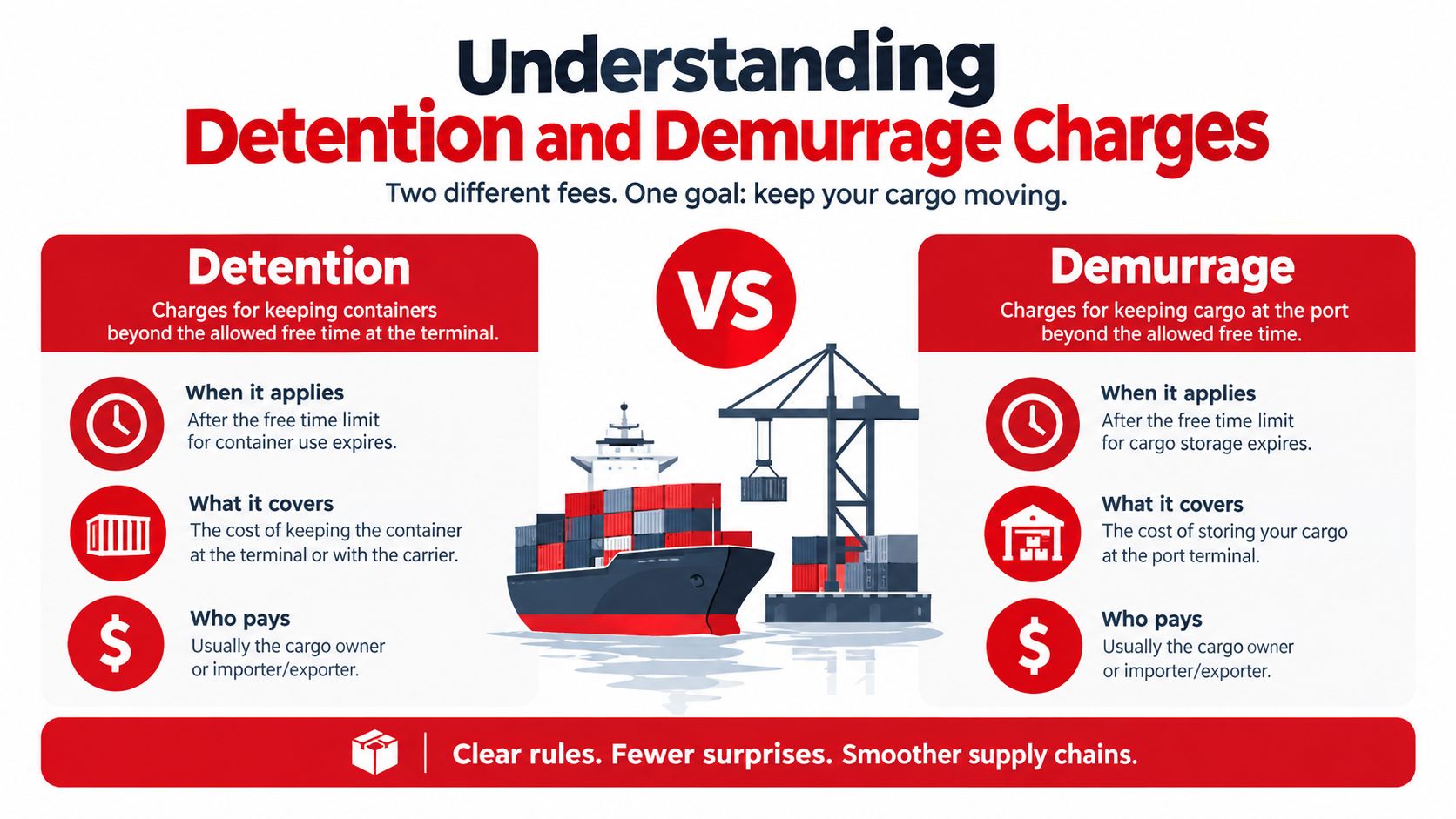
The first distinction is practical, not academic. Demurrage is charged while a full container sits inside the terminal beyond its permitted free time. Detention begins after the container leaves the terminal and remains out, usually because the loaded box hasn’t been returned or the empty equipment hasn’t reached the designated depot within the agreed period. The same shipment can incur both charges at different stages.

Two clocks, one operational problem
Demurrage protects terminal capacity. If full containers remain in the stack, the terminal has less room to receive new imports and less flexibility to handle vessel discharge. Detention protects the carrier’s equipment pool. A container that stays with a consignee or shipper too long isn’t available for the next booking.
The labels matter because the responsible party, evidence, and corrective action can differ. A customs hold may keep the box inside the terminal, creating a demurrage dispute. A missed empty return appointment after delivery can create detention, even when the terminal delay has already ended.
| Charge | Container location | Typical operational response |
|---|---|---|
| Demurrage | Full container inside the terminal after free time | Secure customs release, pickup access, truck capacity, and terminal appointment |
| Detention | Container outside the terminal after the allowed return period | Complete unloading and return the empty unit to the correct depot |
| Related storage costs | Cargo or equipment held under separate terminal or contract terms | Check the tariff, booking terms, and invoice basis before accepting liability |
The mistake that costs most is treating both charges as a generic “late container fee.” That approach hides the event that started the clock. A disciplined forwarder asks where the box was, which milestone triggered the charge, who controlled the next action, and what the contract says about exceptions.
Practical rule: Every dispute should begin with a location and timestamp, not with an argument about whether the invoice feels excessive.
Understanding Detention and Demurrage Charges
At the core, detention and demurrage are charges for using terminal space or container equipment beyond an agreed free-time window. The window isn’t a universal entitlement. It depends on the carrier, terminal, route, container type, contract, shipment status, and sometimes the import or export direction.
For most import shipments, one industry guide places common demurrage free time at 3 to 7 calendar days, while detention free time commonly ranges from 5 to 10 days, as summarized by StoneX’s explanation of demurrage. Those ranges are useful for planning, but they shouldn’t replace the actual booking confirmation or tariff. A shipper must identify the exact start event, the last free day, whether weekends and holidays count, and the location where the empty container must be returned.
How the calculation works
A simplified calculation is:
Chargeable days × applicable daily rate = assessed fee
The difficult part is determining the first term. The chargeable period may begin when the container is discharged, when the terminal makes it available, when the vessel berths, or under another contractually defined event. It may end when the container gates out, when the empty unit is accepted at the designated depot, or when the carrier confirms another qualifying event.
Daily rates can also step up as the container remains unpaid or unreturned. A benchmark cited by StoneX reported average combined detention and demurrage costs of $123 after 7 days and $537 after 14 days for 20-foot dry containers across ports and shipping lines. Those figures aren’t a quotation for a particular shipment, but they show why a delay that looks manageable on the first day can become a serious margin problem later.
The practical record should contain:
- Free-time terms: The number of allowed days and whether the clock runs on calendar or working days.
- Milestone timestamps: Discharge, availability, customs release, pickup, gate-out, unloading, empty return, and depot acceptance.
- Exception evidence: Terminal closures, appointment failures, customs instructions, equipment shortages, and documented carrier or port restrictions.
- Invoice logic: Container number, charge period, rate tier, currency, and the party identified as liable.
A shipment team that needs coordinated sea transport services should request these terms before booking, not after the invoice arrives. The most reliable cost forecast is built from the contract and event data together. A rate sheet without milestone definitions is incomplete, and a tracking dashboard without the governing tariff is just a timetable.
Why These Fees Are So Expensive Now
The headline explanation often blames shippers for collecting cargo too slowly. That explanation is incomplete. Importers can cause avoidable dwell by submitting documents late or failing to arrange transport, but a container can also remain trapped because customs has selected it for inspection, the terminal has no appointment capacity, or a congestion event has disrupted normal release patterns.
The regulatory record shows how large the financial category became. The U.S. Federal Maritime Commission says the total amount of detention and demurrage billed by nine reporting carriers increased roughly nine-fold between Q2 2020 and Q1 2022, and that billed and collected amounts at their peak in Q4 2024 were 85% higher than in Q2 2020. Those figures come from the commission’s detention and demurrage reporting summarized in the FMC overview of detention and demurrage.
Congestion turns a contract clock into a systems problem
A terminal may make a container available while the wider transport chain remains unable to move it. The customs declaration may be incomplete, inspection capacity may be constrained, trucks may be scarce, or appointment slots may be released later than the free-time plan assumed. The carrier’s invoice records elapsed time, but it doesn’t automatically explain why the elapsed time occurred.
Recent industry coverage described a 17.4% rise in global container terminal dwell time versus a 2023 baseline and attributed 21.8% of triggering incidents to customs compliance inspections. The figures, reported in JCtrans coverage of detention and demurrage pressures, reinforce an operational point: a significant share of charge exposure can originate in inspection and terminal processes rather than deliberate inaction by the consignee.
That changes the mitigation strategy. A team that only tells the warehouse to unload faster is addressing the final stage of the problem. It should also ask whether customs documents were complete before arrival, whether the broker received the right commercial data, whether the terminal’s availability notice was reliable, and whether the trucker could obtain a workable appointment.
A free-time allowance doesn’t create terminal capacity, customs availability, or truck supply. It only defines when the financial clock starts to matter.
The cost of delay is not evenly distributed
The same number of delayed days can have different consequences depending on where the container is in the process. Before discharge, a schedule change may allow the importer to reschedule transport. After discharge and customs release, the same delay may leave only a narrow pickup window. After gate-out, the priority shifts to unloading and empty return.
This is why a single global “days in transit” metric has limited value. Operations teams need separate clocks for terminal dwell, customs status, truck appointment, warehouse receiving, and empty return. They also need escalation rules that identify who acts when one clock approaches its limit.
Navigating Recent Regulatory Changes
U.S. rules have made billing discipline an operational requirement, not merely a legal preference. The Federal Maritime Commission’s final rule requires vessel-operating common carriers and marine terminal operators to issue detention and demurrage invoices within 30 calendar days from when the charges were last incurred. A billed party receives at least 30 calendar days to request mitigation or a refund, and the billing party must attempt resolution within 30 calendar days when the request is timely, as outlined in Xeneta’s summary of the FMC detention and demurrage data and rules.
Those windows don’t mean every invoice disappears. They mean the shipper or forwarder has a defined process, and the billing party has defined timing and content obligations. A dispute that arrives late, lacks event evidence, or fails to identify the specific charge is still weak.
A practical dispute sequence
The operations team should treat every invoice as a controlled case file:
- Record receipt. Save the original invoice, the date received, the sender, and the shipment reference. Don’t rely on a forwarded email that may omit attachments or change the apparent receipt date.
- Check required details. Match the container number, charge type, charge period, applicable rate, free-time terms, and billed party against the booking and arrival records.
- Build the event timeline. Pull terminal availability, customs release, pickup attempts, gate-out, unloading, empty return, and depot acceptance timestamps.
- Separate controllable and external delay. A late customs document should be handled differently from a terminal appointment failure or an official inspection hold. Each needs its own supporting record.
- Submit the request within the dispute window. State whether the request seeks a refund, mitigation, or correction, and attach evidence rather than sending a general complaint.
- Track the response. Keep the request, acknowledgement, correspondence, revised invoice, and final decision in the shipment file.
A customs and international transport partner such as an international transport and customs service can help coordinate the documents and milestones, but the shipper still needs to define internal ownership. The best dispute process assigns one person to collect evidence and another to approve the commercial response.
The liability question is narrower than many explainers suggest
A court decision on September 23, 2025 set aside the FMC rule’s section concerning who may receive the invoice, while the billing-timing and content requirements remained in force, according to the FMC’s account of the court decision. This distinction matters. The invoice-recipient issue cannot be treated as though the entire billing framework vanished.
Shippers should therefore review three separate questions. What does the transport contract say about liability? Does the invoice contain accurate and sufficient information? Was it issued within the applicable period? The answer to one question doesn’t settle the others.
Contractual Protections and FETEIA and FIATA
Regulation sets a floor for billing conduct. The transport contract determines much of the commercial risk above that floor. It can define free time, approved return locations, notice obligations, liability for customs delays, force majeure treatment, subcontracting, claims procedures, and the evidence required to support a waiver.
FETEIA and FIATA don’t perform the same role. FETEIA is the Spanish industry federation whose approved contracting conditions can establish a framework for freight-forwarding relationships in Spain. FIATA is an international federation that provides model approaches and insurance-related reference points for the forwarding sector. Neither framework automatically makes every detention or demurrage charge the forwarder’s responsibility.
Comparing the two frameworks
| Framework | Primary function | What a shipper should examine |
|---|---|---|
| FETEIA-approved conditions | Spanish freight-forwarding contracting framework | Scope of the forwarder’s service, liability allocation, claims procedure, and client obligations |
| FIATA references | International forwarding standards and insurance context | Limits, exclusions, documentation requirements, and the relationship between liability and cover |
| Carrier and terminal terms | Shipment-specific operational rules | Free time, charge triggers, return depot, rate tiers, exceptions, and billing party |
The important question isn’t whether a forwarder has a recognized framework. It’s whether the framework is incorporated into the engagement and understood before a delay occurs. A shipper should ask for the applicable terms, identify the party controlling customs and transport instructions, and confirm what happens when the delay sits outside that party’s control.
Novocargo operates under contracting conditions approved by the Spanish Freight Forwarders Federation, or FETEIA, and maintains civil liability insurance within limits set by FIATA. That fact supports a structured risk discussion, but it isn’t a promise that every container charge is insured or transferable. Insurance always depends on the policy, the event, the exclusions, the contractual liability, and the claim documentation.
For teams revising shipping agreements, contract templates from LegesGPT can provide a starting point for organizing clauses and responsibilities. Legal review remains important where the contract allocates customs, terminal, equipment, or delay risk across multiple jurisdictions.
The useful contract is the one that answers who must act, by when, with which document, and who pays if that action cannot happen.
Proven Strategies to Avoid These Fees
Avoidance starts before the container reaches the port. A shipper that waits for the invoice has already surrendered the most valuable control point. The operating team should map the shipment from document preparation through empty return, then place an owner and a timestamp against every event that can consume free time.
The following checklist works because it connects commercial terms to physical actions:
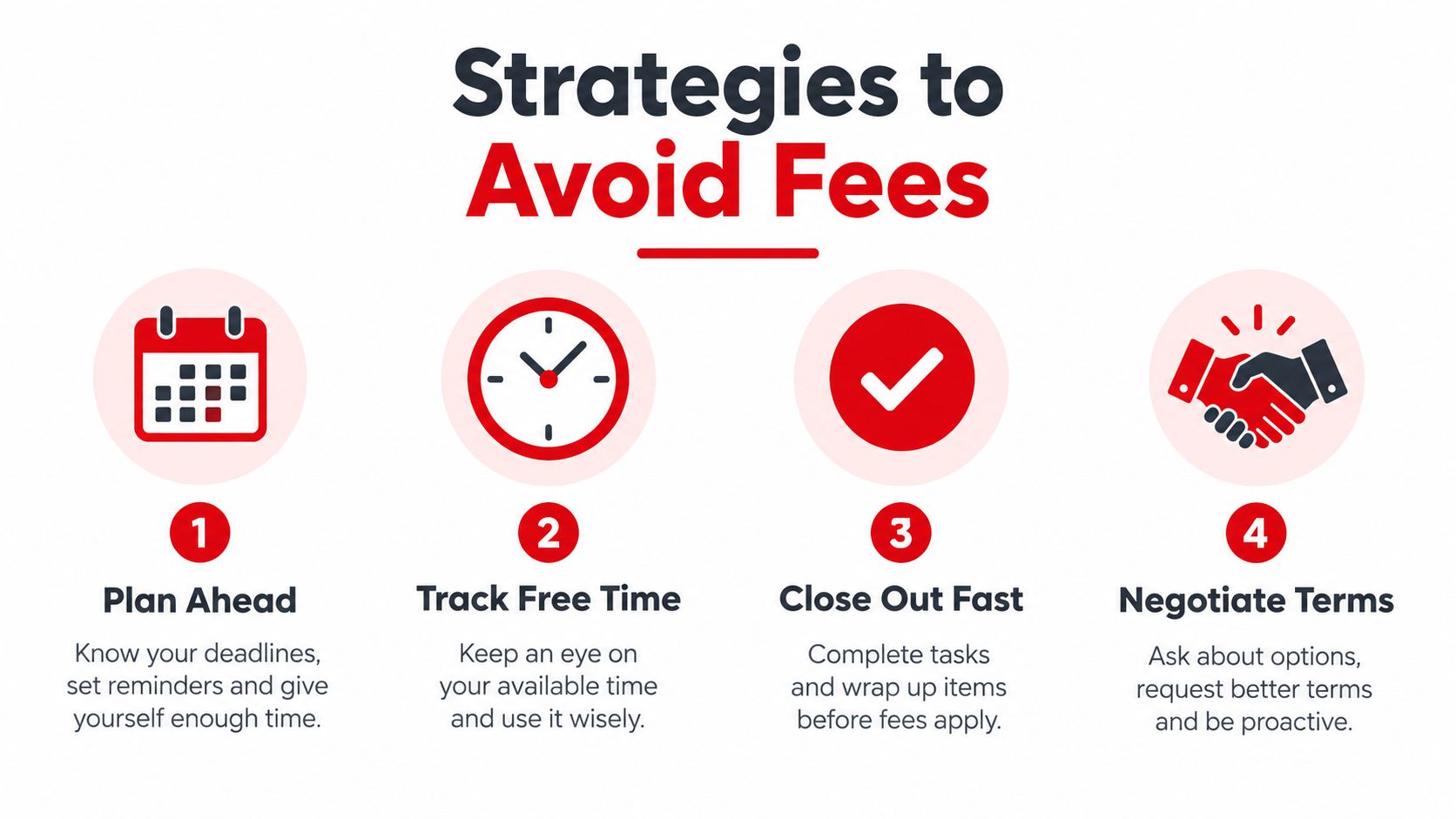
- Plan ahead: Confirm the carrier’s free-time rules, terminal procedures, customs data requirements, and empty return location before the booking is finalized.
- Track the right clock: Record the actual availability date, customs status, last free day, pickup appointment, gate-out, unloading completion, and empty acceptance. An estimated vessel arrival isn’t enough.
- Close out quickly: Release the container from the terminal, unload it, and return the empty equipment as separate tasks. A delivery confirmation doesn’t prove that the carrier accepted the empty unit.
- Negotiate terms: If the cargo requires inspections, specialist handling, or a long inland leg, request terms that reflect the operating pattern before the shipment moves.
Use a decision matrix, not a default container choice
Container selection affects handling, loading speed, equipment availability, and the likelihood of an exception. The lowest nominal freight rate may not produce the lowest landed cost if the cargo requires special loading or if the chosen equipment is difficult to source at the origin.
| Operating condition | Planning priority | Better decision |
|---|---|---|
| Standard, stable cargo | Reliable pickup and predictable unloading | Match equipment to volume and loading process, then protect the pickup slot |
| Cargo requiring special handling | Prevent loading or release complications | Confirm equipment availability and terminal acceptance before booking |
| Inspection-sensitive cargo | Reduce document and customs uncertainty | Submit complete commercial and compliance data early and preserve every release notice |
| Congested destination | Protect against a narrow collection window | Coordinate broker, trucker, warehouse, and terminal status in one shared timeline |
A container transport service should be evaluated on more than equipment availability. The provider should be able to explain how it monitors free time, what happens when a terminal changes an appointment, and how it records an attempted pickup that failed for reasons outside the driver’s control.
The video below illustrates the operational importance of controlling container movement and handoffs.
Make the escalation trigger explicit
The strongest teams don’t wait until the last free day to discover that customs hasn’t released the shipment. They use alerts at meaningful milestones, with a named person responsible for the next action. If customs is pending, the broker owns the document review. If the box is available, the drayage provider owns the pickup plan. If the loaded container has left the terminal, the warehouse owns unloading and the equipment desk owns the return.
What doesn’t work is a shared inbox with no clock owner. It also doesn’t work to track only the vessel schedule, because the vessel can arrive on time while the cargo remains unavailable. Event records should be retained in a format that can support both operational decisions and a later invoice challenge.
Mastering Your Logistics Costs
Detention and demurrage become manageable when the business separates three questions. What happened physically? What did the contract require? What does the invoice prove? The first question needs timestamps, the second needs shipment terms, and the third needs a controlled billing review.
The definitions remain the starting point. Demurrage concerns a full container inside the terminal after free time. Detention concerns equipment outside the terminal that hasn’t been returned within the permitted period. The definitions alone, however, won’t protect a margin when customs inspections, terminal congestion, and appointment failures consume the same clock.
A stronger operating model combines:
- Pre-arrival control: Complete customs data, confirm equipment, and identify the free-time trigger before the vessel arrives.
- Live exception management: Assign ownership when cargo is unavailable, an appointment fails, or an empty depot rejects the return.
- Contract awareness: Keep the carrier tariff, forwarding terms, and shipment-specific instructions with the operational file.
- Invoice discipline: Verify dates, rates, charge type, and billed party, then use the applicable dispute window without delay.
The regulatory environment adds weight, but it also raises the standard for recordkeeping. A shipper can’t rely on a general statement that the port was congested. It needs the terminal notice, appointment history, customs status, carrier correspondence, or other evidence that links the delay to the charge period.
Teams building a wider governance model can use proven export management frameworks as a reference for connecting documentation, compliance, and operational ownership. The central lesson is straightforward: freight cost control belongs in the shipment workflow, not in a finance review performed weeks later.
The companies that handle port crises best aren’t necessarily the ones with the longest free-time allowance. They’re the ones that know when each clock starts, who owns the next move, and which records will prove what happened. That discipline turns detention and demurrage from an unexpected penalty into a visible, reviewable supply-chain risk.
Novocargo coordinates sea, air, and land freight, customs support, and multimodal logistics with documented processes designed to reduce avoidable delays and clarify responsibility. Visit Novocargo to discuss a shipment plan that protects free time, manages customs milestones, and gives the operations team a clearer path for handling detention and demurrage.


 1Merchandise Processing Fee: A ...
16 October 2026
 2Carga Consolidada: Qué es y Có...
25 July 2026
 3Hub Logístico: Qué es y por qu...
17 July 2026
en concreto?
Comentarios (0)
No hay comentarios todavía. ¡Se el primero!