


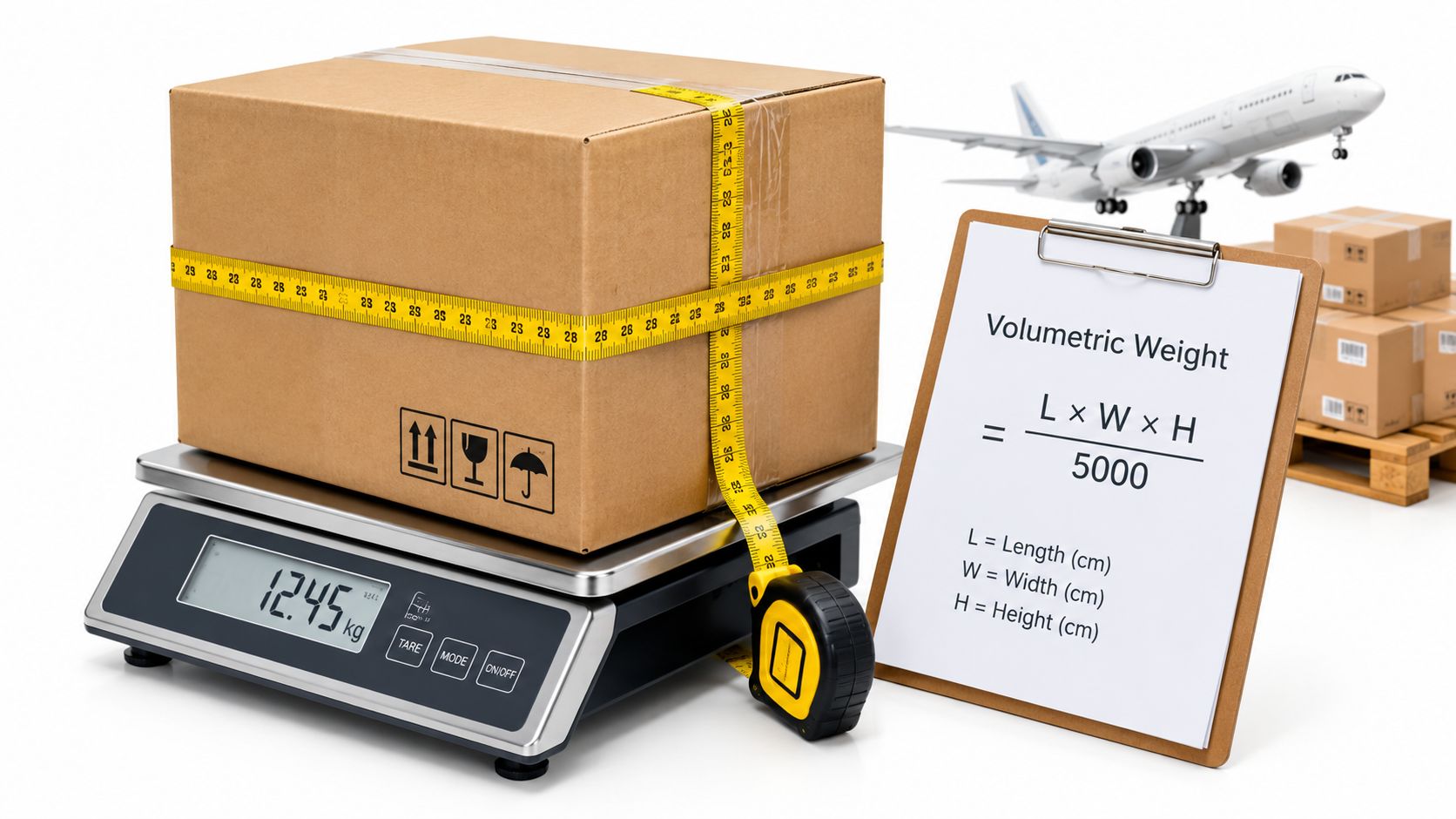

Air Freight Dimensional Weight Calculator Guide
09 October 2026
A carton can leave a warehouse weighing 12 kg, yet the air freight invoice can charge considerably more. The scale isn’t necessarily wrong. The carrier may be billing for the space that carton occupies, using dimensional weight, also called volumetric weight.
That difference creates confusion during quote comparisons, invoice checks, and landed-cost planning. An air freight dimensional weight calculator can perform the multiplication, but the harder question is choosing the correct tariff: which divisor applies, how the carrier measures the package, and where rounding changes the result.
Table of Contents
- Why Your Air Freight Invoice Looks Bigger Than Your Scale
- The Dimensional Weight Formula Explained
- Measuring and Converting Units the Right Way
- Different Divisors Across Carriers and Forwarders
- Rounding Rules That Quietly Change Your Final Bill
- Smart Packing Tips to Lower Your Chargeable Weight
Why Your Air Freight Invoice Looks Bigger Than Your Scale
Air cargo pricing has to account for two constraints at the same time. An aircraft has limited payload capacity, but its cargo hold also has limited usable volume. A lightweight carton filled with textiles or protective packaging can consume valuable space long before it reaches the weight limit.
Dimensional weight converts that space into a comparable weight figure. The carrier calculates the shipment’s volume, applies the divisor specified by its tariff, and compares the result with the actual scale weight. The higher figure becomes the chargeable weight used for the freight calculation, as described in IATA’s guidance on air cargo tariffs and rules.
Practical rule: The scale tells the carrier how heavy the cargo is. The dimensional calculation tells the carrier how much aircraft capacity the cargo occupies.
This explains why a quote based on product data can differ from an invoice based on the tendered carton. A sales team may provide inner-product dimensions, while the airline or handler measures the sealed outer package. Tape, corner protection, protruding straps, and irregular bulges all increase the measured footprint. Freight handlers generally use the extreme outer dimensions, not the neat dimensions printed on a product specification sheet.
The issue also affects rate shopping. Two forwarders can receive identical shipment details yet return different chargeable weights if they apply different divisors or rounding stages. A shipper evaluating ways to cut shipping costs from China therefore needs more than a freight rate. The quote should show the measurement basis, divisor, rounding method, and any minimum chargeable weight.
For time-sensitive cargo, the air transport service decision also depends on those details. Once the chargeable figure is understood, the apparent invoice surprise becomes traceable. The remaining sections show how to calculate it, verify the tariff, and reduce avoidable volume.
The Dimensional Weight Formula Explained
The arithmetic is simple. The tariff selection is where most mistakes begin.
For standard international air cargo, the commonly used formula divides the shipment volume in cubic centimetres by 6,000. The result reflects a target density of about 167 kg per cubic metre, or 10.4 lb per cubic foot, according to the IATA air cargo tariff reference.
Consider a carton measuring 60 × 50 × 40 cm with an actual weight of 12 kg:
- Multiply the three outer dimensions: 60 × 50 × 40 = 120,000 cubic centimetres.
- Divide the volume by 6,000: 120,000 ÷ 6,000 = 20 kg.
- Compare the dimensional result with the scale reading.
- Use the higher value as the chargeable weight.
The carrier therefore charges against 20 kg, not 12 kg, before applying its billing increments or other freight terms.
| Measurement Type | Input Values | Calculation | Result (kg) |
|---|---|---|---|
| Scale weight | Carton weighs 12 kg | Direct weighing | 12 |
| Dimensional weight | 60 × 50 × 40 cm | 120,000 ÷ 6,000 | 20 |
| Chargeable weight | Higher of the two results | Higher figure selected | 20 |
Dimensional weight isn’t a penalty added after weighing. It is a way to compare cargo that uses aircraft space differently. A kilogram of dense metal and a kilogram of foam have the same mass, but the foam may occupy much more room. The volumetric calculation makes that difference visible on the shipment record.
The AUSFF volumetric weight guide provides useful background on the relationship between dimensions, actual weight, and billable weight. It also reinforces an important distinction: dimensional weight is calculated, actual weight is measured, and chargeable weight is the higher figure selected under the applicable service rules.
The formula can stay unchanged while the answer changes because the divisor belongs to the tariff. A carrier, forwarder, parcel service, or consolidation program may use a different divisor. That makes an air freight dimensional weight calculator only as reliable as the service assumptions entered into it.
Measuring and Converting Units the Right Way
A calculator produces a plausible-looking answer even when the units are mixed. That makes unit errors especially dangerous. The dimensions, divisor, and output unit must belong to the same formula.
For the metric route, the standard air cargo calculation is:
Length in centimetres × width in centimetres × height in centimetres ÷ 6,000 = dimensional weight in kilograms.
A carton measured in inches needs an inch-based divisor and normally produces a result in pounds under the relevant carrier formula. The IATA tariff guidance identifies the metric air freight basis as 6,000 cubic centimetres per kilogram, equivalent to the recognised imperial relationship of 166 cubic inches per pound. The critical point is consistency. A centimetre measurement must not be divided by an inch divisor, and an inch measurement must not be treated as centimetres.
Measure the package carriers receive
The measurement should cover the finished consignment, not the product cavity. A practical sequence is:
- Seal the carton first. Tape and closure flaps can alter the outer profile.
- Measure the longest points. Include protrusions, bulges, straps, and protective corners.
- Record all three dimensions. Do not replace a fractional measurement with a smaller whole number.
- Use one unit system. Keep centimetres with the metric divisor and inches with the applicable imperial divisor.
- Record the method. The shipment file should show whether measurements were taken before or after carrier-specific rounding.
Pallets require the same discipline, but the measured object is the completed palletised consignment. Overhang, uneven stacking, stretch film, and corner protection can determine the extreme length, width, or height. An irregular package shouldn’t be measured as though it were a perfect rectangular box.
Control rounding before calculation
Carriers can round dimensions before multiplying, or apply rounding after calculating the volumetric result. Those workflows aren’t interchangeable. The FleetWorks dimensional-weight guidance notes that handlers may measure outer extremes and apply their own rounding rules, which can produce a different billed result from a basic spreadsheet.
A reliable internal record should preserve the unrounded measurements, the converted measurements, the divisor used, and the carrier’s final rounded figure. That audit trail helps explain why a calculator estimate and an invoice don’t match without assuming that either side made a mathematical mistake.
Different Divisors Across Carriers and Forwarders
The divisor is a tariff choice, not a universal law of arithmetic. A lower divisor produces a higher dimensional weight for the same package, while a higher divisor produces a lower result. The shipper therefore needs the service type and rate card before entering a figure into an air freight dimensional weight calculator.
Verified air cargo guidance commonly uses 6,000 cubic centimetres per kilogram, while other logistics materials describe equivalent volumetric relationships and note that parcel or shipment-specific formulas can use different values. The IncoDocs air freight calculation guide highlights the commercial importance of checking the applicable divisor rather than assuming that every carrier uses the same one.
The table below uses the verified 60 × 50 × 40 cm carton from the standard air cargo example. It doesn’t assign unsupported carrier-specific tariffs. Instead, it shows how the same volume changes when a confirmed service divisor changes.
| Service Type | Divisor (cm) | Divisor (inches) | Formula | Worked Example (60×40×40 cm, 10 kg) |
|---|---|---|---|---|
| Standard air cargo tariff | 6,000 | Equivalent imperial basis varies by tariff | L × W × H ÷ divisor | 96,000 ÷ 6,000 = 16 kg, then compare with 10 kg |
| Alternative forwarder tariff | Confirm from rate card | Confirm from rate card | L × W × H ÷ stated divisor | 96,000 ÷ stated divisor, then compare with 10 kg |
| Parcel or express service | Confirm from carrier | Confirm from carrier | Carrier formula and rounding rules | 96,000 ÷ stated divisor, then apply carrier rounding |
The table’s blank tariff fields are deliberate. A calculator shouldn’t present a guessed divisor as a fact. A quote should state whether the rate uses metric or imperial dimensions, which divisor applies, and whether the result is rounded before or after comparison with actual weight.
Ask what the quote actually covers
A forwarder may quote an airline rate, a consolidated service, or a parcel-style product. Those products can use different billing conventions. A shipper arranging international transport and customs should request the complete chargeable-weight method alongside the base rate.
The Trade Cost explanation of air volumetric weight records the historical shift from a 7,000 divisor to a standard 6,000 divisor before 2017, a change that increased the chargeable weight of light shipments by roughly 17% for identical dimensions. That history shows why old spreadsheets and supplier quotations can remain misleading even when the multiplication is correct.
Before comparing proposals, the shipper should ask:
- Which divisor applies to this exact service?
- Are the dimensions measured in centimetres or inches?
- Does the quote use package dimensions or pallet dimensions?
- When does rounding occur?
- Is the higher of actual and dimensional weight used?
- Are minimums or billing increments included?
Rounding Rules That Quietly Change Your Final Bill
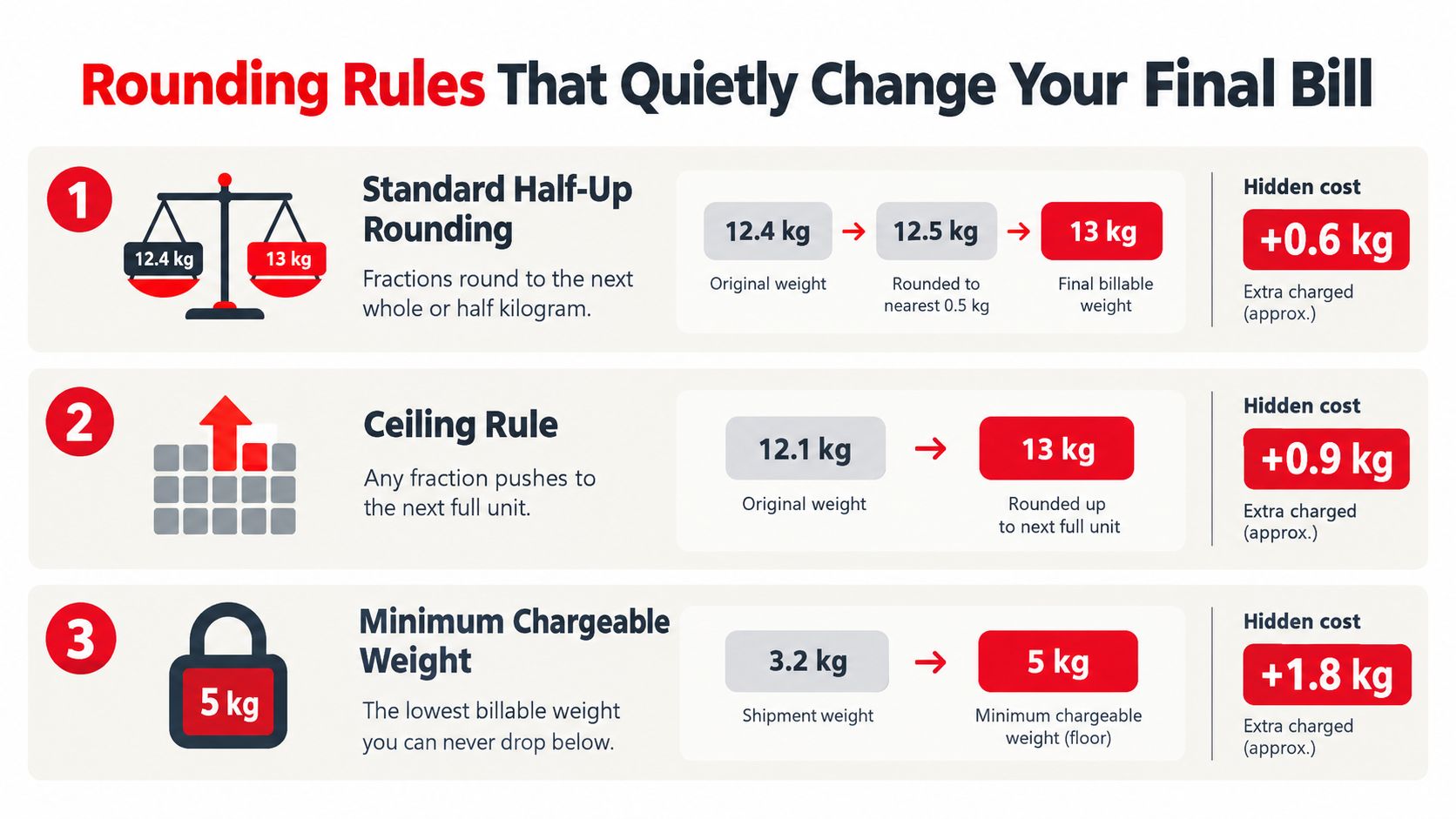
Many calculators stop after dividing volume by the divisor. Carriers don’t always stop there. They may round each dimension before calculating, round the calculated weight to a whole kilogram or half kilogram, or apply a service-specific billing increment.
The FedEx dimensional weight explanation says that each package dimension can be rounded to the nearest whole inch before division by 139 for United States and international shipments. Other logistics tools describe rounding volumetric weight to the next full pound or half kilogram after calculation. The same carton can therefore produce different chargeable outcomes depending on where the rounding occurs.
Compare the calculation stages
Suppose a calculation produces 6.4 kg before the carrier applies its billing rule. One tariff might move that result to the next half kilogram, another might move it to the next whole kilogram, and a ceiling rule might always push any fraction to the next full unit. These aren’t alternative mathematical answers. They’re different commercial instructions applied after the volume calculation.
A dimension-first process can create another difference. If each side is rounded upward before multiplication, the volume increases before division. If the carrier uses the precise measured dimensions and rounds only the final result, the calculated weight may be lower. This is why a shipper should retain raw measurements instead of storing only the rounded dimensions printed on a booking form.
Billing check: Ask whether rounding happens on dimensions, calculated weight, or both. A quote that omits this point isn’t fully auditable.
Minimum chargeable weights create a separate floor. A shipment can calculate below the service minimum yet still be billed at that minimum. The exact floor depends on the lane and tariff, so it should be requested in writing rather than assumed from a generic calculator.
The practical workflow is straightforward:
- Save the carrier’s stated measurement rule.
- Enter the outer dimensions without reducing fractions.
- Apply the confirmed divisor.
- Compare the result with actual weight.
- Apply the stated rounding and minimum.
- Check the invoice against each stage.
That process turns a disputed adjustment into a sequence of verifiable inputs. It also shows why the question isn’t just, “What is the dimensional weight?” The better question is, “Which chargeable-weight rule did this service apply?”
Smart Packing Tips to Lower Your Chargeable Weight
Packaging changes work best when they target the dimensions that inflate volume, not just the material weight. A lighter carton isn’t automatically cheaper if it occupies the same space. The priority is to protect the product while reducing unused outer volume.
Start with the carton shape
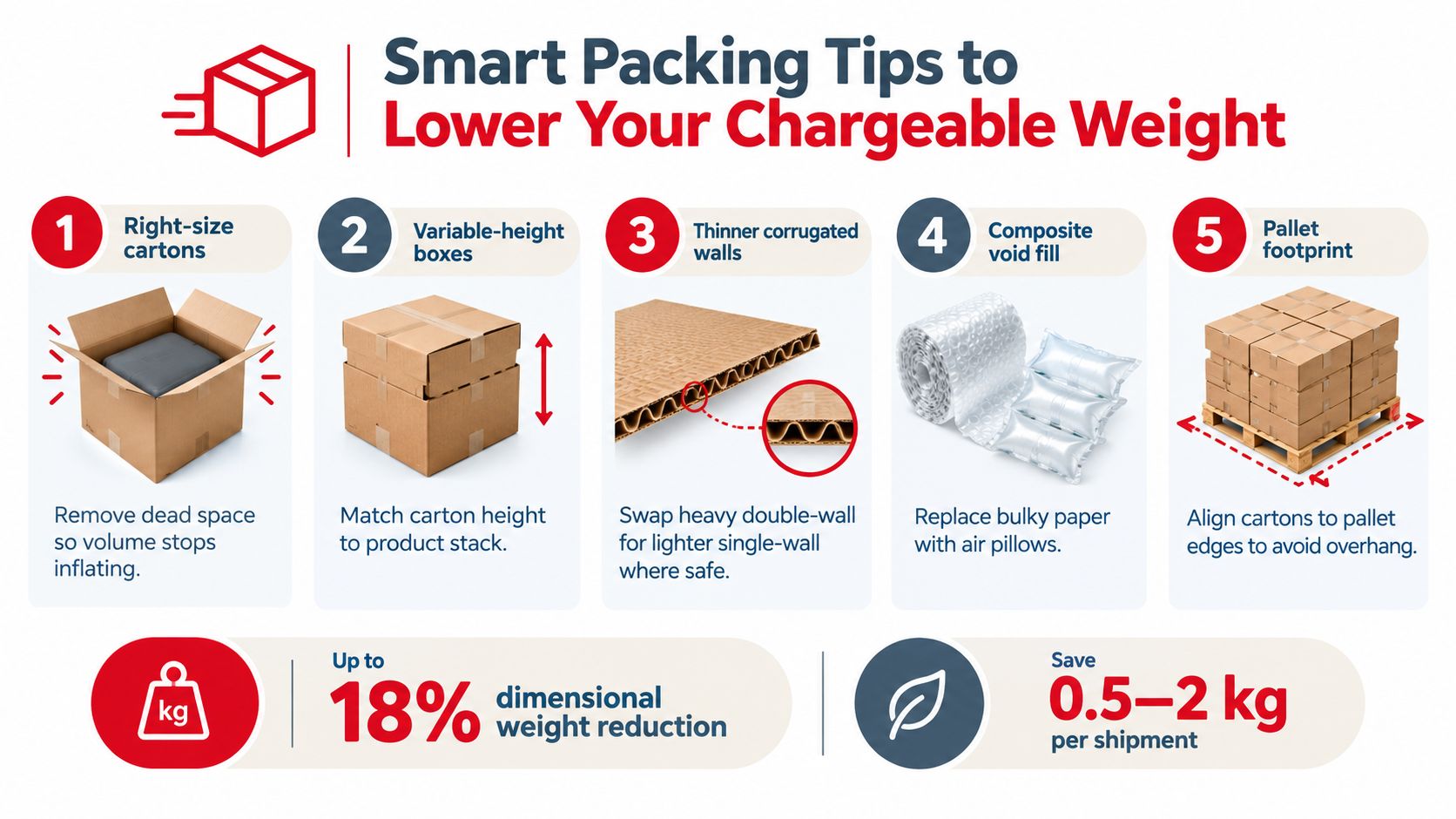
Right-size the outer carton. A box that leaves large voids increases the calculated volume even when the contents are compact. Packaging teams should test the smallest safe carton and compare its finished outer dimensions, not just its internal cavity.
Match height to the product stack. Fixed-height cartons often leave unused vertical space when order quantities vary. Variable-height boxes or controlled cutting can bring the top of the carton closer to the contents.
Review wall thickness carefully. A thinner corrugated board can reduce the outside dimensions, but only where compression, stacking, moisture, and handling tests show that protection remains adequate. The cheapest box isn’t the right box if damage creates replacement freight and claims.
Reduce avoidable void volume
Replace bulky void fill where suitable. Air pillows or other compact protective materials can occupy less space than loose paper, but the chosen method must suit the product’s fragility and movement risk. The packing instruction should specify how much protection is required rather than leaving the decision to each operator.
Bundle compatible units. Several individually packed items may use more total packaging than a stable multi-pack. Bundling can reduce repeated walls, labels, and empty pockets, although the combined carton must remain safe to lift and stack.
Consolidate only when the handling profile supports it. One well-packed carton may use space more efficiently than several small cartons. However, a larger package can become harder to handle, more vulnerable to damage, or subject to a different service condition. The dimensional result should be compared with the operational risk.
Validate the complete shipping profile
Palletisation changes the object being rated. Cartons aligned with the pallet edges usually create a more predictable footprint than cartons with overhang or uneven stacking. Stretch film, corner boards, and the final stack height must be included in the measured consignment.
Packaging teams can also ask the forwarder these questions before booking:
- Does the rate card use centimetres or inches?
- Which divisor applies to the selected service?
- Does the carrier round dimensions before calculation?
- Is there a minimum chargeable weight or billing increment?
- Are pallet dimensions measured after wrapping?
- Can the forwarder offer a different tariff for consolidated volume?
- Will the quoted chargeable weight be recalculated at the handling terminal?
The packaging classification guide can help teams organise packaging decisions around the article being shipped, its protection needs, and its handling characteristics. Those decisions should feed directly into the dimensional-weight worksheet.
A short training video can reinforce the measurement sequence for warehouse staff:
The strongest control is procedural. Staff should measure the sealed outer package, record the exact dimensions, identify the divisor from the booking, and compare the carrier’s billed weight with the saved calculation. That routine makes packaging optimization measurable without relying on a generic calculator that hides tariff assumptions.
Novocargo helps companies coordinate air, sea, and land freight, manage international logistics, and address customs and foreign-trade requirements. For a shipment review that includes dimensional weight, packaging, and route planning, visit Novocargo and discuss the cargo profile with its logistics team.


 1Merchandise Processing Fee: A ...
16 October 2026
 2Carga Consolidada: Qué es y Có...
25 July 2026
 3Hub Logístico: Qué es y por qu...
17 July 2026
en concreto?
Comentarios (0)
No hay comentarios todavía. ¡Se el primero!